
Lesson 6 - Yeast Propagation
This lesson explores yeast propagation, the supply of pitching yeast and its fitness for purpose. We will explore yeast cultures and the protocols for its storage, along with how to propagate new cultures within the laboratory. This knowledge will enable us to demonstrate an understanding of the design features required for a yeast propagation plant.
Yeast Supply
We will now consider how yeast cultures are stored, recovered from storage and the cultures used in propagation.
Storing yeast cultures
Although this is quite a challenge, the aim is to keep the cells for as long as possible in a way where they are free from contamination, do not change in any way and do not die. There are a number of options, some more successful than others and all with different costs.
The general principle is that they are kept at low temperatures, which slows down cellular activities so that they can survive for longer periods of time using reserve materials such as glycogen to keep them going. Other methods remove cellular water with varying degrees of success, as we shall see.
Some low temperature storage methods use cryoprotectants. These are relatively inert chemicals, such as glycerol, that protect delicate cell membranes from damage caused by ice-crystal formation.
Non-growing cells are a lot more resistant to being put into storage than actively growing ones since they have already adapted their genomes to withstand starvation.
The following methods are those most often used:
-
Slope cultures – slopes (or slants) are the method of choice for routine handling of yeast cultures. They are glass bottles containing a nutrient medium that is suitable for yeast and solidified with agar. The bottles are placed at an angle when the medium is still molten so that when it sets, it forms a ‘slope’. This maximises the surface area for growth.
The agar is inoculated and incubated; a surface coating of yeast cells is formed, and the slopes are kept in a refrigerator at 2-4°C.
Periodically, the yeast is sub-cultured onto a new slope and the process repeated at intervals – called ‘subbing’.
-
Storage at -80°C – lag phase culture plus cryoprotectant, usually 50:50 mixture of cell suspension and glycerol, is transferred to a glass or plastic vial and the mixture held in a refrigerator at -80°C.
-
Freeze drying (lyophilisation) – this technique uses specialised equipment. A lag phase culture plus cryoprotectant is pipetted into a glass vial and attached to a machine that freezes the cells under a vacuum. This removes water by sublimation, which is the process by which a solid turns directly into a gas without passing through a liquid phase. The dried culture is sealed into the glass vial for storage. This used to be the standard method for storing yeast cultures, but it has since been shown to be very harsh and is no longer used.
-
Storage in liquid nitrogen – lag phase culture plus cryoprotectant used to be dispensed into a sterile straw. After sealing, the straw is placed into a container in a specialised refrigerator, essentially a flask containing liquid nitrogen at around -195°C. Many curators of yeast banks have now replaced the straws with cryopreservation beads, as discussed above. In order not to kill the cells at this very extreme low temperature, the rate of freezing has to be controlled carefully.
More information about the strengths and weaknesses of the methods used to store yeast and other cells types can be read about in the following paper:
Smith, D. & Ryan, M. (2012). Implementing Best Practices and Validation of Cryopreservation Techniques for Microorganisms. Scientific World Journal; 2012: 805659.
Published online 2012 May 2. doi: 10.1100/2012/805659
-
Active dried yeast – this is different to freeze-drying in that fed-batch cultivation is used. The process used for making active dried yeast is shown below:
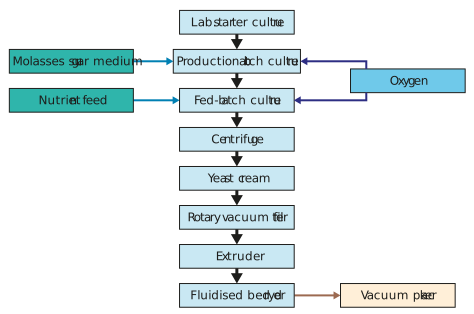
Figure: Outline of the process used for the production of dried yeast
The process is quite complex and requires specialised equipment, as the diagram indicates. The key difference between this and conventional propagation is that sugar molasses, a specialised medium, is used. This has a high sugar content, and in order to improve the yield, additional nitrogenous nutrients are also added. The growth stages are highly aerobic, and after an initial batch growth phase, which exhausts the sugar, additional medium is fed into the propagator. The additional nutrients are metered in throughout the growth phase in a carefully controlled manner to ensure extremely high yields.
Following the growth phase, the yeast is dried using a multi-stage process, as indicated, after which it is vacuum packed.
What is a fed-batch culture? When glucose is present, metabolism is always fermentative, and alcohol and CO2 are the primary products formed. This happens even if oxygen is present. It is called the Crabtree effect. It is what we see in brewery propagations using wort as the source of yeast nutrients.
In a fed-batch culture, molasses is usually used as the source of sugar. Cultures are highly aerated. The trick is that the sugar is fed into the growth vessel at a rate that means it is used by the yeast as soon as it enters. The result is that the actual glucose concentration at any time is close to zero. The Crabtree effect does not kick in, and the cells are fully respiratory at all times.
This gives a very high yield of yeast, about five times more than we get in a brewery propagation, and the cells are loaded with a lot more sterol and unsaturated fatty acids than we ever get in a brewery fermentation.
The cells are given a final maturation stage which causes them to make a lot of trehalose, this and the high sterol level makes them very resistant to stresses such as drying.
Table: Advantages and disadvantages of methods of culture preservation
|
Method |
Advantages |
Disadvantages |
|
Slope |
Low cost easy to manage |
|
|
-80 °C storage |
Less frequent subbing compared with slope cultures |
|
|
Freeze drying |
Cultures stable for at least one year
Costs not too high |
|
|
Liquid nitrogen |
Current gold standard method
Indefinite storage with no loss in viability |
|
|
Active dried yeast |
Bulk supply of yeast
Shelf life of at least one year if vacuum not broken
|
|
Master cultures
The master culture is the one that is held in whichever type of yeast bank that you choose to use. It is the culture that possesses all the properties you have chosen. These will be a combination of behaviour in fermentation and quality of the beer produced.
A record must be kept of the master culture’s properties; this could be the results of a set of tests based on classical microbiological methods. An underlying assumption is that if we plate out a dilute yeast suspension on a suitable nutrient medium, which is solidified with agar to give separate individual cells, the colonies that will develop after incubation are genetically identical. In other words, clones of each other. Differential and selective media can be used to check purity, and also as a rough guide to the strain’s identity; however, it is much better to use one of the modern genetic fingerprinting techniques.
Another concept is that all the yeast used to make beer will be derived from a single cell. This is quite a sobering thought. If a wort is pitched at 10 million cells per ml, it will have been dosed in 1 x 10¹² cell per hL. That is a lot of yeast!
Some brewers will occasionally make a new master culture from the yeast being used in production. Yeast, which is performing normally, is plated out to give single colonies. Once checked for purity, one colony is used to make the new master culture. Some brewers take a different approach: cells from several colonies might be combined to make the new master culture. This is to allow for the possibility that some production yeast is actually made up of two or more very closely related strains. Combining cells from several colonies allows us to get a representative mixture.
Once we have a master culture genetic fingerprint, we can compare this with any obtained from the production yeast. This provides us with the most definitive proof we can achieve with current methods that no changes have occurred, and two samples are genetically identical.