
Lesson 5 - Yeast Biochemistry SAQ
This lesson enables you to test yourself on the material covered in the Yeast Biochemistry lesson, and determine the level to which you have met the learning outcomes.
Suggested Response - Q1
**Answer both parts of this question.
a) Discuss the differences in the methods used by Saccharomyces yeast to take up maltose and sucrose.
b) What are the principal differences between uptake of nutrients via active transport and facilitated diffusion?
Response:
a) Maltose is taken up by an active system. Sucrose is converted into both fructose and glucose by the enzyme invertase. This enzyme is located in the periplasm, the space between the cell wall and membrane. The fructose and glucose are then transported into the cell.
b) The following diagram summarises the various uptake systems used by cells to transport nutrients into cells.
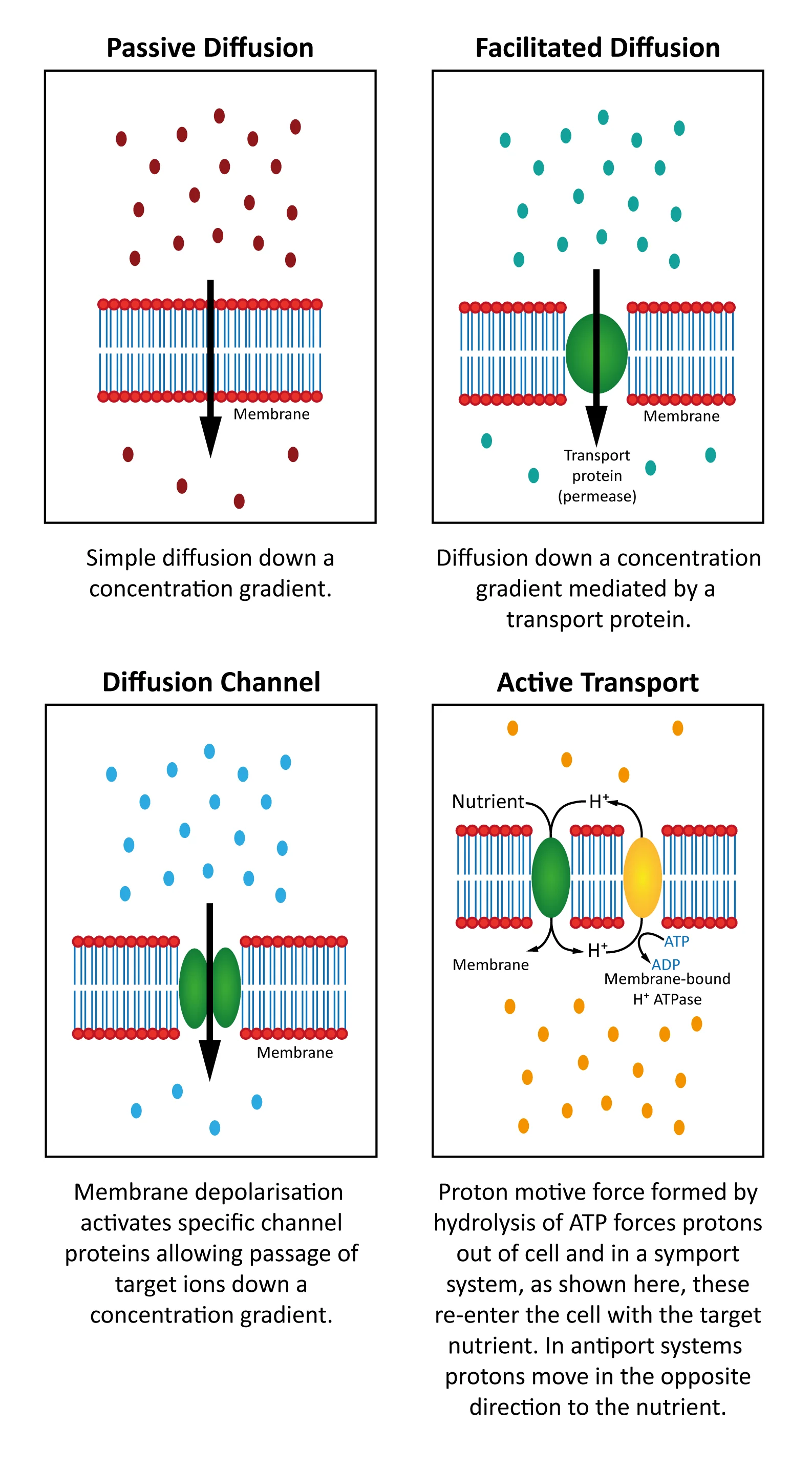
Figure: Uptake systems used by cells to transport nutrients into the cell
Simple diffusion is not possible for most molecules because of the high lipid content of the membrane. Only a few (such as simple gases and ethanol alcohol) use this method. Therefore, the membrane is relatively hydrophobic which makes it difficult for hydrophilic (polar) molecules to cross.
Active transport uptake systems require energy to allow compounds to be taken up. Facilitated diffusion transport systems do not require energy and do not work against a concentration gradient; they use specific proteins, called permeases, to carry the nutrient across the membrane.