
Lesson 4 - Wort Cooling and Oxygenation Technology
This lesson will firstly compare the design and operation of different wort cooling systems, and will give you enough information to help you describe why you would choose one wort cooling system over another. It will then move on to wort oxygenation systems, giving you enough information to help you make the same decision regarding this type of system.
Point of reflection – reconvene
Welcome back. So, what were your thoughts?
Yes, oxygen comes from air. We can use air. But, remember that air is made up of approximately 78% nitrogen and only approximately 21% oxygen. It is thus limited in the amount of dissolved oxygen (D.O.) that it can deliver to the wort in a specific amount of time.
Time is always against us, it seems. Interestingly, nitrogen does not easily dissolve, and can in fact pass through the fermenter and cause thick ‘top foams’ that present additional processing and cleaning problems.
It is the dissolved oxygen (the oxygen in the solution) that is important. This is the only oxygen that yeast can use. Many breweries now brew at high gravity and due to the higher concentration of wort; air alone cannot deliver more than 8–10 mg/L of dissolved oxygen (at wort cooling temperatures). We thus need to replace, or combine, air usage with pure oxygen usage. This is because high gravity wort requires higher levels of dissolved oxygen, as the higher the gravity, the more yeast is pitched and there is lower gas solubility.
The amount of oxygen required is yeast strain, brand and wort gravity specific. However typical values used are 7-18 mg/L. Pure (cylinder) oxygen is already sterile and requires approximately a fifth of the volume requirements needed when using air. However, we must be careful not to over oxygenate. This is certainly possible with oxygen addition, and we thus require careful control, which will be discussed below.
Wort aeration and/or oxygenation is the only place where we welcome the presence of oxygen (for their beer production, yeast propagation aside). Air, with approximately 21% oxygen, can only deliver up to 8-10 mg/L of D.O. We thus need to supplement this with pure oxygen if higher wort D.O.s are needed, particularly with high gravity brewing. Aeration and/or oxygenation can take place on either the hot side or cold side of the wort cooler. Most modern breweries, however, prefer to use the cold side, as gases are more easily dissolved in cold liquids, as shown below. This also prevents the oxidation and increased colour formation of the (hot) wort. Of course, being on the cold side, we would also need to ensure that the gas is sterile.
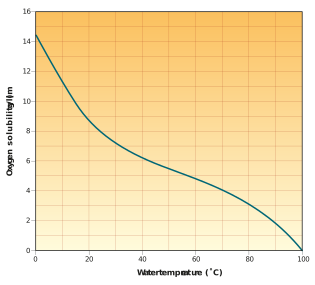
Figure: Oxygen (from air) solubility
The dissolution of a gas depends on the temperature, pressure, area of the gas-liquid interface, and the turbulence. The use of the cold side of the cooler improves the dissolution of the oxygen. However, the use of tiny gas bubbles, which have a larger surface area, and are in a turbulent wort flow, also improves the rapid dissolution of the oxygen.
There are a few technologies that can be used to promote this rapid dissolution of oxygen into our wort:
1. The Venturi
The venturi is made, for example, from a section of 100 mm diameter pipe that has been tapered to 80 mm diameter. As wort flows through the restriction in the venturi, the velocity increases and there is a corresponding decrease in pressure. Oxygen is injected as a bubble stream (as shown in the figure below) at the narrowest point where pressure is lowest. The mixed liquid and gas stream then flows through the region of increasing size, which is highly turbulent and facilitates mixing. Also in this region, the pressure is increasing. Both factors aid gas dissolution.
The Venturi – a restricted section of pipe – is named after Giovanni Venturi (1746-1822), an Italian physicist and science historian. In addition to discovering the effect on a flow of passing through a restricted section of pipe, he is also credited with being one of the first historians to draw attention to Leonardo da Vinci as not just a great artist, but also as a scientist. He clearly had a good eye for detail…
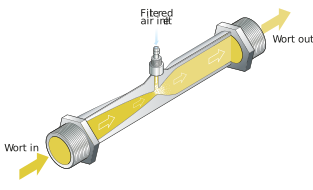
Figure: Venturi aerator
2. Ceramic or Sintered Metal Candles
Oxygen is injected as very small bubbles through fine pores in the candle, into the wort flowing past. These are simple yet very effective aerators; however, they are difficult to clean.
3. Static Mixers
The mixing of wort and oxygen is achieved in a reaction section with built-in angled bands of blades. These systems are less effective at dissolving the oxygen and can also prove difficult to clean.
4. Centrifugal Mixers
Oxygen is forced into the wort by centrifugation and is introduced as very small bubbles. This is a relatively complex technology, which only provides average gas dissolution. These units can be cleaned in place.
It crucially important that the brewer controls the amount of air or oxygen addition. The use of a mass flow meter to measure the dosing of the oxygen is preferred. This overcomes any pressure fluctuations. In practice, only approximately 10-20% of air/oxygen injected dissolves. We would thus also like to use a D.O. measuring meter after the dosing point, to cross check how much oxygen made it into solution. The use of a closed loop control system (see the diagram below) gives more control, but they are not cheap.
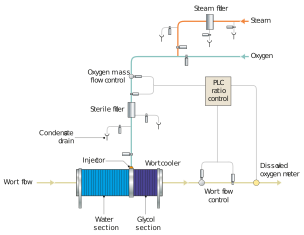
Figure: Wort oxygenation control
These are in-line systems, which are best practice in most large modern breweries. However, particularly in older breweries, wort oxygenation only takes place in the fermentation vessel, and not in-line after cooling. Furthermore, it greatly depends on the beer type being brewed. Air or oxygen addition can be done as a pumped rousing, using either a fishtail design, an injection or is simply bubbled into the fermenter. These techniques are generally much more inefficient for gas dissolution and can therefore cause carbon dioxide break-out and excess foaming.
Ale brewing typically uses higher fermentation temperatures, cooling wort to around 15-22°C and as such, ambient water can be used for wort cooling. Lager brewing, however, generally uses lower fermentation and cooling temperatures. These are typically 6-12°C and as such, a separate coolant or two are used to cool the wort.
Hot wort aeration was also typically used by ale brewers, as the oxygen catalyses the browning reactions (Maillard reactions) to produce more colour.
Low oxygen levels can lead to sluggish fermentations. This results in high final pH values and gravities, leading to an unfermented, sweet beer. Furthermore, with low yeast growth, we would have insufficient yeast to re-pitch and would more than likely have yeast with a low viability and vitality. The oxygen levels are beer-brand specific, which is based on the type of yeast, and how the brewery has cultured it via their yeast management practices.
In Module 2 we will learn more about flavour formation in the fermenter with yeast metabolism. But for now, it will suffice to say that the amounts of D.O. supplied will also be matched to our brand-taste requirements. The brewer can vary the amount of D.O. (especially using pure oxygen from a cylinder) to produce, for example, higher alcohols and esters, and as per ale brewing.
As a final note, oxygenating the yeast is only important if the yeast is being re-used. Many brewers use dried yeast, and these cells have enough lipid material to successfully complete a fermentation. Thus, no oxygenation is required if you are using dried yeast.