
Lesson 4 - Wort Cooling and Oxygenation Technology
This lesson will firstly compare the design and operation of different wort cooling systems, and will give you enough information to help you describe why you would choose one wort cooling system over another. It will then move on to wort oxygenation systems, giving you enough information to help you make the same decision regarding this type of system.
Plate Heat Exchangers (PHE)
We will now consider today’s technology, to align ourselves with best practices for efficient, large scale cooling. We will begin with plate heat exchangers. As an aside, please note that plate heat exchangers and coolships do both have a large surface area for cooling in common – we will come back to this!
Typical temperatures ex-wort clarification are 96-98°C at sea level. This allows for some heat loss after boiling at ±100°C. We then typically reduce the temperature down to 6-20°C, depending on the beer style we are brewing.
As shown in the diagram below, we can see the temperature set points across the heat exchanger. These are not random numbers but instead represent a highly engineered relationship between the size of the heat exchange (number of plates) and the desired exit temperature of our cooled wort. The number of plates provides the combined large surface area for cooling.
For example (as shown below): 100 hL of wort at 97°C will be cooled to 16°C using approximately 110 hL of chilled water at 10°C. This will then be heated to produce hot brewing water up to 85°C. This would be used for a certain sized heat exchanger (number of plates and thus cooling area) with a certain flow rate of water and wort, for the required cycle time.
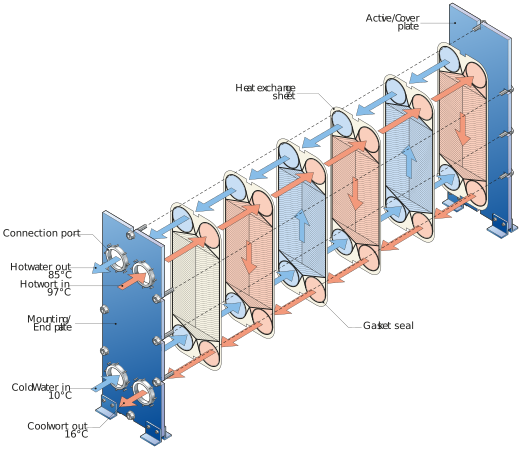
Figure: The plate heat exchanger
In order to decrease wort temperature, we need to know:
- The temperature of the hot wort.
- The temperature of the cooling medium.
- The desired exit temperature of our cold wort.
- The flow rates of the hot wort and cooling medium (this is given by the cycle time requirements e.g. we typically want to cool within 60 mins or less).
The size of the heat exchanger can then be calculated as: the surface area needed, from the combined number of plates, to achieve the specific temperature decrease within a certain time. We can also calculate the exit temperature of the cooling medium as this heats up, by removing the heat from the wort.
To achieve a lower exit temperature from a plate heat exchanger, we can choose from one of the follow options:
-
Increase the number of plates (e.g. make the heat exchanger bigger).
-
Slow the flow rate down to give more time for the required heat exchange to occur.
-
Change the refrigerant to create a colder temperature.
-
Introduce a second stage refrigerant (see later in the lesson). This is usually an upfront design consideration. Although not impossible to change later, this is difficult and costly.
We can see from the above diagram that the two media (wort and water) flow in opposite direction. This is called counter current flow; it improves the heat transfer of the wort cooler. The media are separated by gaskets and regular scheduled maintenance checks are needed to ensure that these gaskets remain in prime condition, to prevent any mixing. In addition, the pressure in the main product is typically higher than on the coolant side. However, we do not want to get product into the coolant medium either, although it is a lesser of two evils.
Interestingly, we usually generate an equal volume of hot water to the volume of wort that we cool or slightly in excess, at a ratio of 1.1 : 1.0. Also noteworthy, is the fact that the heat exchanger plates are not smooth! Instead, they have a raised (embossed) surface, typically in a chevron style. This increases the surface area and enhances turbulent flow, which again, improves the heat transfer.
We can also see from the above diagrams that water is the cooling medium. Why is water normally used in breweries to cool our wort, instead of glycol, or even ammonia (which has fantastic refrigeration capacities and capabilities)? The objectives give the answer. We need to recover and reuse some of the very high amounts of energy that are locked within the hot wort.
Using cold water means that we can immediately reuse this energy as hot water for brewing:
- If we used ambient water, either cooling would take longer, or we would need massive heat exchangers to deliver the desired cooling rate (temperature decrease within the prescribed amount of time). Furthermore, ambient water can vary within and across breweries, thus is not a good coolant. As already stated, wort cooling is a precise engineering relationship that has been designed and sized accordingly.
- We can make hot water! This is the key to unlocking the heat entrained in the hot wort. Brewers need a lot of hot water for brewing. This hot water can be mixed with ambient water to create a range of brewing water temperatures, using water mixers.
- If there is a gasket failure and subsequent accidental mixing in the wort cooler, then it is mixed with brewing quality water.
The quality of chilled water is important. We must have brewing (product) quality water for this purpose, even though it is being used for processing purposes. We now know, from the above, that the chilled water becomes our hot water. From here, we can mix this hot water with ambient water. This gives us our brewing water, at whatever temperature we require.
Plate heat exchangers are the most common and preferred heat exchangers used for cooling wort. This is mainly due to their:
- Improved efficiency (highly conductive, very thin, profiled plates).
- Compact size and versatility (small gap between plates, easily extendable).
- Inspectability (relatively quick to disassemble).
- Ease of maintenance (no moving parts).
- Low cost of maintenance and replacement parts (gaskets and plates).
- Cleanability using reverse flow (directional changes also possible).
With reference to the final point listed, plate heat exchangers are readily cleanable, using a centralised cleaning in place system (CIP). The steel plates can withstand the high temperature (80-85°C) and often use a caustic soda (NaOH) cleaning regime. The gaskets, however, must be regularly inspected and maintained, as they can perish and also act as microbial growth sites. The CIP is usually carried out in a reverse flow direction to the wort, for a more effective clean. This cleaning not only removes organic deposits from the wort, but also any scale, as fouling reduces the heat transfer efficiency.