
Lesson 6 - Wort Boiling Final SAQ
This lesson allows you to test yourself on the material covered in all previous lessons on ‘Wort Boiling’ and determine the level to which you have attained the outcomes.
Suggested Response - Q3
***Using diagrams, describe the features of internal and external calandrias. A colleague has asked for your advice on whether to install an internal or external calandria. Provide the pros and cons of each system to help them make a more informed choice.
Response:
Internal calandrias
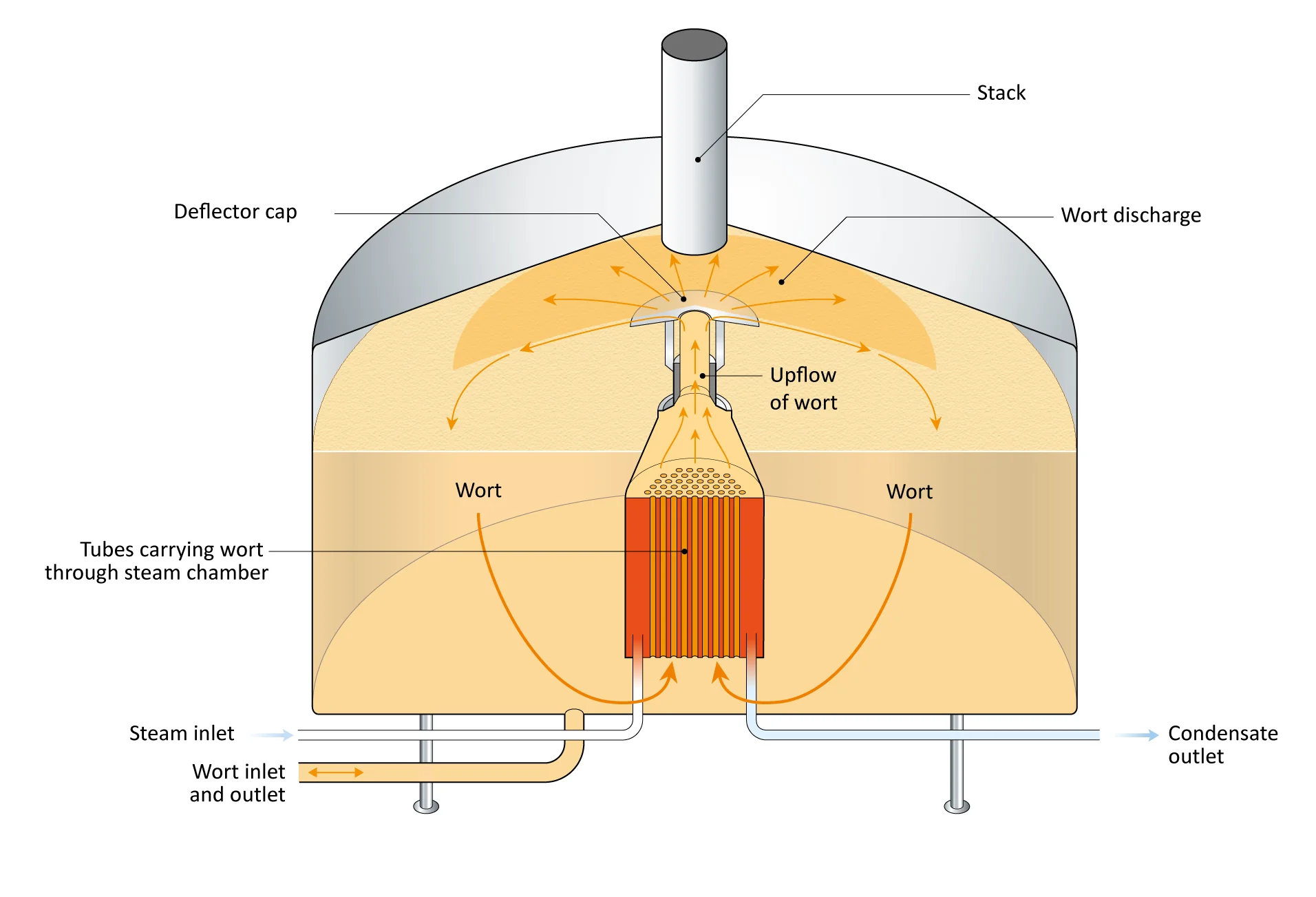
Along with the calandria itself, internal calandrias feature:
- Steam inlet with air release and condensate return.
- Cone to direct the wort to the wort spreader.
- Adjustable wort spreader.
- CIP facilities (usually fixed spray balls above calandria tubes).
- System to mount the calandria in the kettle.
Some models also incorporate:
- Different tube sizes for control of boil.
- Recirculation pump.
- Wort distribution equipment that induces a venturi in the flowing wort.
- Additional surface area for volatile removal.
- Mechanically controlled multilevel wort spreader.
- Aperture to allow wort to be fed back under the wort’s surface.
- Control system including position sensing.
The advantages of internal calandrias are:
- Low investment cost, with little maintenance and wear (unless automated and pumped).
- No electrical energy required (unless pumped).
- No heat losses (all heat produced goes into the wort).
- It is possible to use a low steam pressure (1 bar overpressure).
- Low foam formation.
- Low shear boiling.
- No agitator required.
The disadvantages include:
- Cleaning the calandria tubes is not easy; the kettle may need to be full of cleaning solution in order to clean inside the tubes (leading to high water use and effluent costs).
- Usually needs to be cleaned more frequently than an external calandria.
- Flowrate through the calandria is usually lower than that through an external calandria so wort thermal load, fouling and flavour and colour pickup can be high if ΔT is high.
- Not able to heat wort to boiling until calandria is almost submerged (jackets or a preheater are often required).
- Part brews are not possible (for the same reason). Some modern internal calandrias have shorter tubes to help overcome this problem.
External calandrias
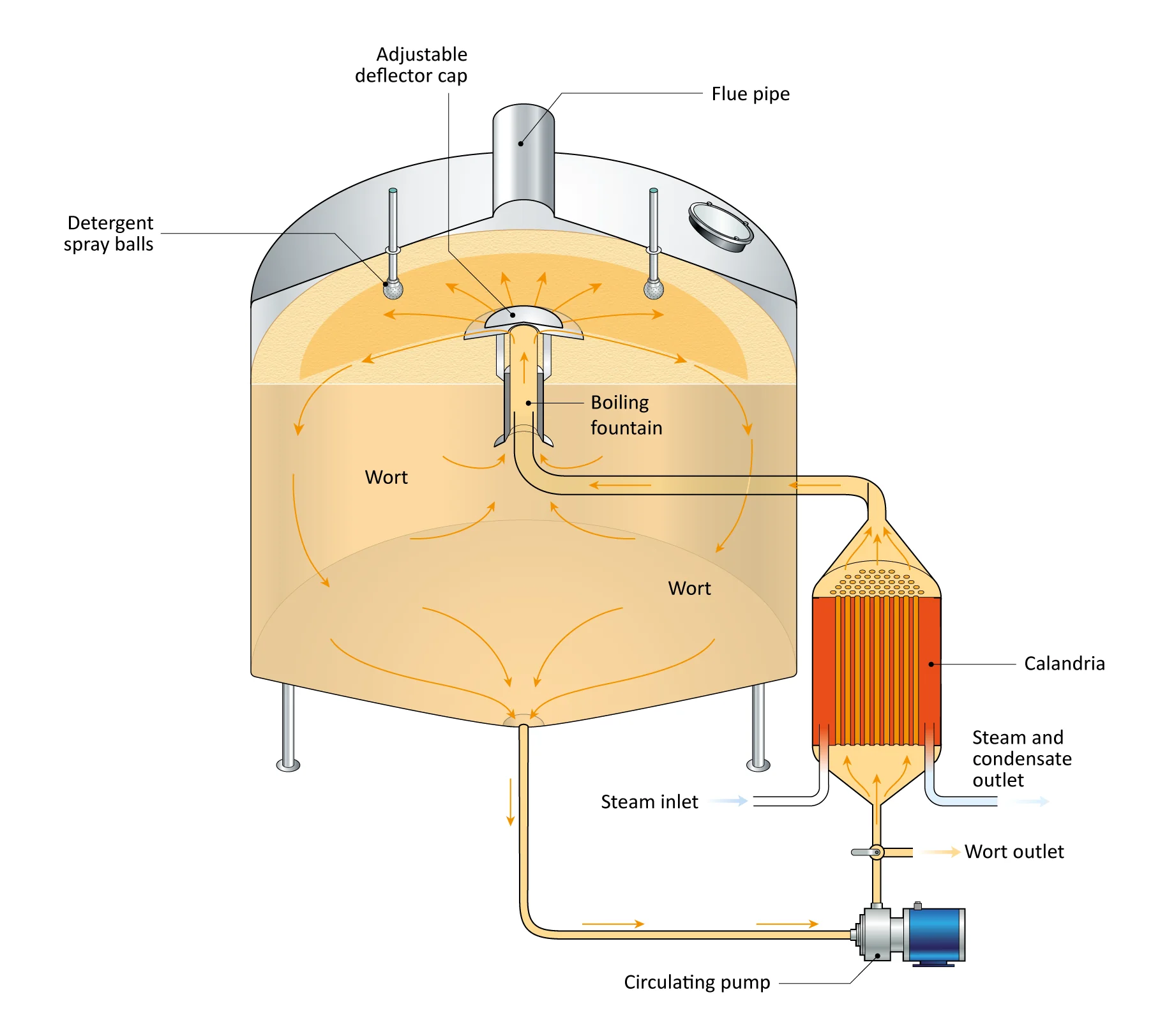
In addition to the heat exchanger element and enclosure, external calandrias include:
- Steam inlet with air release and condensate return.
- Wort recirculation pipework.
- Wort recirculation pump.
- Adjustable wort spreader (unless wort is returned tangentially).
- System to mount the calandria on the brewhouse floor.
- Insulation and cladding.
In addition, some models include:
- Valve to restrict return wort flow to provide back pressure.
- Pressure/temperature measurement.
- Control system.
The advantages of the external calandria include:
- If used, the overpressure and higher temperature allows for reduced boiling time (due to the faster bitterness extraction and trub formation). The same wort quality provided by 10% evaporation per h 90 min boil can be achieved with 5-6% per h evaporation in 60 min.
- Very low steam pressures can be used in long tube versions.
- Wort boiling can start earlier than with an internal calandria. As wort is pumped through the external calandria as soon as there is enough wort to keep the system flooded heating to the boil can begin. This saves time and ensures the wort does not cool too much before heating can begin, thus saving energy.
- Foaming is less than most internal calandrias and heating jacket systems.
- Some external calandrias can be cleaned in place independently of the kettle.
- Optimum heat transfer and turbulent conditions mean a lower rate of fouling than an internal calandria. This increases the number of brews between cleaning.
- Using a combined kettle-whirlpool removes the transfer time between the kettle and whirlpool from the brewhouse cycle time (although the kettle is tied up all the time the wort is clarifying and being cast out to fermentation). It also removes the potential for trub damage during transfer.
The disadvantages of the external calandria include:
- Additional electrical consumption by pump.
- The external calandria needs to be insulated to help prevent heat losses.
- Shear can be high in the pumped circulation versions.
- More equipment to maintain than an internal calandria.
This should give our colleague a good idea of which option is right for them. We should also recommend speaking to suppliers, asking them for data to support claims and for reference sites that have recently installed the technology.