
Lesson 6 - Wort Separation Process Control
This lesson deals with wort separation process control. The different methodologies of measuring and calculating extract recovery are explained and demonstrated. A methodology is explored, as is how to investigate and resolve performance issues with extract efficiency, wort quality, and cycle time.
Low Extract – Troubleshooting
If our calculated extract efficiency recovery to the kettle is below standard, we need to act to correct this. Where do we start?
Let us use this troubleshooting chart to try and understand what our issue is:
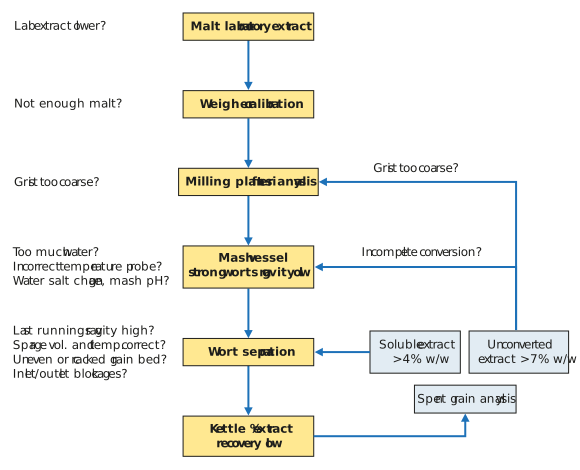
Figure: Troubleshooting for low extract recovery
We will first focus on the efficiency of mash conversion. If this is not 100%, then we cannot expect 100% at wort separation!
At mashing, we have added a known mass of extract in a known volume of water. If we have mashed at 3 L/kg, the SG of the mash wort will typically be 1.080 or 19.3 ˚P. It is important that we sample the mash for this gravity check, rather than the separated strong worts. The strong worts will be diluted by the underlet water of our mash tun or lauter tun.
So, what might be causing mash gravity variation?
- Mash water flow meter calibration. Has the correct volume of water been added?
- Malt laboratory extract. Has this changed?
- Weigher calibration. Are we adding the correct amount of malt? Are there any discrepancies in malt stocks?
- Plansifter analysis. Is the profile correct? Adjust roller mill settings or hammer mill screen sizes to correct.
- Mash vessel temperature probe calibration. Is the mash at the correct temperature?
- Mash vessel ionic conditions. Has the water composition changed, thus affecting mash pH?
If our mash gravity is as expected, but our kettle gravity is low, this suggests an inefficiency at wort separation. This will show up as a higher than normal last runnings gravity at the end of wort collection. There will also be a higher than normal soluble extract in the spent grain.
If our wort separation device wort outlet has an in-line density meter, we will observe a different gravity profile, and the last runnings gravity will be higher than our normal SG 1.004-1.006. In any case, a high last runnings gravity indicates a sparging issue.