
Lesson 5 - The Mashing Process SAQ
This lesson provides the opportunity for you to test yourself on the material covered in Lesson 4 on The Mashing Process and determine the level to which you have attained the expected outcomes.
SAQ Suggested Response - Q3
**Sketch a mashing profile for a beer produced from a grist of 30% maize grits and 70% under-modified malt. Explain what is happening at each stage of the process.
Response:
Our mashing profile could look like this:
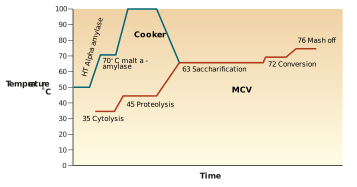
Our maize grits gelatinise at above 70℃, so if we added them to the MCV, their starch would not be available for conversion until β-amylase is denatured. To avoid a very low fermentability, we, therefore, need to process them separately to gelatinise the starch before adding them to the malt mash. If we have the option of using exogenous enzymes, we can add a heat stable α-amylase to the cereal cooker to liquefy the maize starch during the ramp up to the boil. If not, we can add 10% malt grist to the grits and incorporate a stand at between 70℃ and 75℃ to liquefy some of the starch as it is gelatinised. One of these options is necessary to prevent the mash viscosity in the cereal cooker from increasing to the point where the agitator can no longer operate.
The heat and action of boiling the maize mash will help liquefy the maize starch further (to a degree) before it is added into the malt mash.
For the under-modified malt, we need to incorporate stands for cytolysis and proteolysis to finish the maltster’s job. During these stands, we degrade any problematic pentosans, β-glucans and proteins and expose the starch granules for liquefaction and saccharification.
The cooked cereal mash is then added to raise the whole mash to saccharification temperature where β-amylase operates at its maximum rate and α-amylase with be operating to a limited extent.
A short 72℃ stand will allow malt α-amylase to convert any remaining starch. β-Amylase will still be operating in the ramp up to and start of this stand, converting any chains of glucose residues produced to maltose. We could opt to omit this stand if we have a negative starch endpoint test and cycle time was more important than extract and fermentability.
We would mash off at 76℃, which will inactivate most enzymes and reduce the mash viscosity to allow it to be pumped to wort separation more easily.