
Lesson 4 - The Mashing Process
This lesson discusses the process of mashing. It provides an overview and sets out the objectives of the process before explaining what parameters need to be controlled to ensure success. It describes the various methods used to mash and their impact on the wort produced. Finally, it details the composition of wort produced by mashing.
Isothermal Mashing
The word isothermal comes from the Greek word isos meaning the same, and thermal meaning temperature. So, an isothermal mash is one that is maintained at a single temperature. It is the method of choice for ale producers in the UK and for smaller brewers across the world. In fact, more breweries use this method than any other.
Isothermal mashing is carried out in a mash tun. The mash tun doubles as a wort separation device. A mash tun does not have the ability to heat or mix the mash, so the temperature used is determined by the strike temperature of the mashing water. Most mash tuns are insulated, so they are able to maintain the temperature produced at the start of mashing.
What do we need to consider when selecting our temperature for an isothermal mash? The first important consideration is the need to gelatinise the starch. Our temperature, therefore, needs to be above 62℃. Temperatures above 62℃ are above the optima for proteolytic and cytolytic enzymes, so very little breakdown of β-glucan and protein occurs. If we opt for 63℃, β-amylase is at its optimum temperature, so the proportion of maltose in the wort is likely to be high. However, α-amylase activity at this temperature is relatively low, so extract recovery will be low, and starch degradation will be slow. 63℃ is above the optimum temperature of limit dextrinase, so what few limit dextrins are produced by α-amylase will be debranched at a low rate. The inability of limit dextrinase and α-amylase to help degrade the large polysaccharides means that some dextrins remain in the wort, but the optimal activity of β-amylase ensures that fermentability is still relatively high. Beers produced from this wort will have low levels of residual carbohydrate and hence good biological stability (less prone to spoilage) and possibly a lighter body. The risk of a lighter body is reduced as there will be limited proteolysis at this temperature, so higher molecular weight proteins/polypeptides should not be scarce.
If we select 66℃ we arrive at a compromise temperature between the optima for α-amylase and β-amylase. At this temperature, although both amylolytic enzymes are not at their optima, they are able to work together to liquefy, convert and saccharify the starch molecules. At this temperature, we achieve best compromise between extract yield and fermentability. The figure below shows the activity of α-amylase and β-amylase over a range of temperatures and our compromise temperature of 66℃.
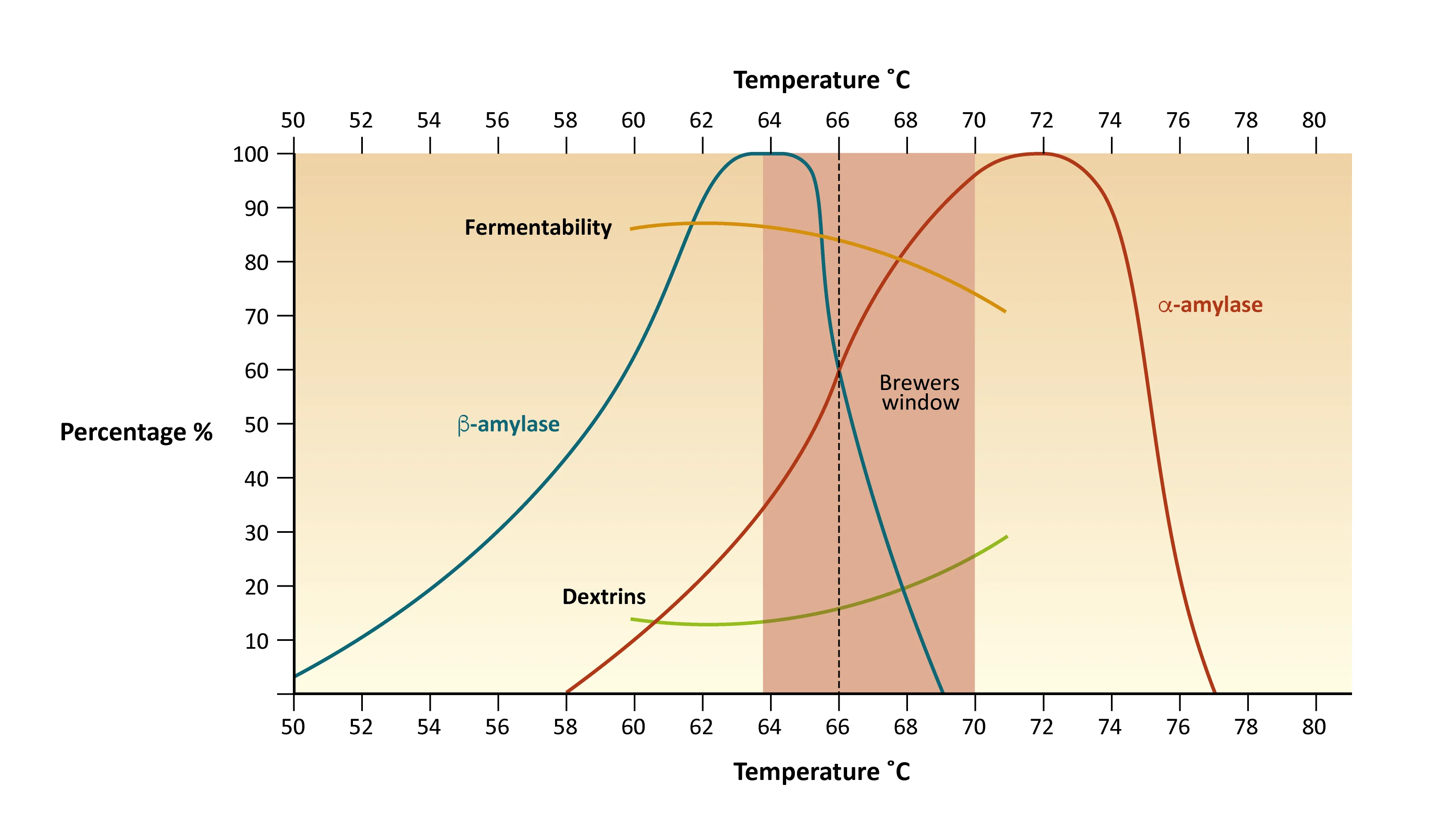
Figure: α-amylase and β-amylase activity over a range of temperatures
Because the β-amylase activity is reduced, the fermentability of this wort is lower than in a 63℃ mash but not so low that the beer would be biologically unstable. With temperature increases beyond 67℃, the fermentability of the wort declines rapidly.
As cytolytic and proteolytic enzymes are above their opima at all temperatures typically used in isothermal mashing, the malt used must be well-modified.
A mashing temperature of around 66℃ is considered a good mashing temperature for well-modified malt in an isothermal mash.
Isothermal mashing is quick, simple to perform and has the lowest equipment cost. However, extracts are low, the malt required is expensive, and the options for adjuncts are restricted to more costly pre-gelatinised products. Our next mashing method does not have all of these problems. Let’s find out some more about temperature-programmed mashing next.