
Lesson 4 - The Mashing Process
This lesson discusses the process of mashing. It provides an overview and sets out the objectives of the process before explaining what parameters need to be controlled to ensure success. It describes the various methods used to mash and their impact on the wort produced. Finally, it details the composition of wort produced by mashing.
Single-Vessel, Temperature-Programmed Mashing
In single-vessel, temperature-programmed mashing, we hold the mash at a range of temperatures for set periods of time. This enables us to provide the enzymes we need to work with, their optimum temperature.
While isothermal mashing is undertaken in a mash tun, we use a mash conversion vessel (MCV) to perform temperature-programmed mashing. MCVs are insulated stainless steel tanks with a means to heat and mix the mash. We will cover MCVs in detail in the Mashing Technology lesson. In most MCVs, an automated control system coordinates the heating and mixing of the mash to achieve the mashing programme.
The figure below shows an example of a temperature profile for a temperature-programmed mash. It also shows the enzyme which is most active at each stand.
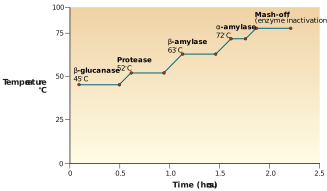
Figure: Temperature profile for a temperature-programmed mash
By enabling each enzyme to work optimally, temperature-programmed mashing enables us to process under modified malt or batches of malt where we are unsure of its degree or homogeneity of modification.
Temperature-programmed mashing is the most flexible mashing method. For varying levels of modification, we can, to a limited extent vary the number and length of the temperature stands employed. We can also use temperature-programmed mashing to produce wort with a required level of fermentability and to influence beer flavour and foam potential.
The variety of adjuncts that can be used in single-vessel temperature-programmed mashing is usually limited to the same range we can use in isothermal mashing.
We have said that temperature-programmed mashing is able to process poorly modified malt. What would happen if we used the mashing temperature profile in the figure above on well-modified malt instead?
Give yourself 5-10 min to think about this and then click ‘Next’ to continue with this lesson.