
Lesson 4 - The Mashing Process
This lesson discusses the process of mashing. It provides an overview and sets out the objectives of the process before explaining what parameters need to be controlled to ensure success. It describes the various methods used to mash and their impact on the wort produced. Finally, it details the composition of wort produced by mashing.
Temperature
If we had to pick a single most important factor that affects the outcome (successful or otherwise) of mashing, it has to be temperature. Temperature affects our access to the starch and the effectiveness of our enzymes. Let’s start with access to starch.
Access to starch
For starch hydrolysis to be successful, we need to gelatinise starch granules. Gelatinisation essentially opens the starch granules up, allowing water and enzymes to enter, thus enabling hydrolysis. For gelatinisation to occur, the starch needs to be raised beyond a specific temperature in the presence of water.
Although essential during mashing, barley starch granules don’t need to be gelatinised for their hydrolysis to be catalysed by barley enzymes. Barley grains germinating in the maltings or in the soil aren’t heated to 62℃ and still manage to change the starch into sugar for the growing embryo. Despite being called an endo enzyme, ɑ-amylase can catalyse the hydrolysis of starch on the outside of the granules producing chains for β-amylase and α-glucosidase to turn into barley baby food (sugar for the growing embryo). We could ask, why do we need to gelatinise starch in mashing then? The answer is that seedling growth is measured in weeks, while mashing is measured in minutes. In fact, if we mashed at 20℃, the mash would almost certainly start fermenting/souring before we achieved our target extract efficiency!
The gelatinisation of starch granules differs from cereal to cereal, variety to variety and even from harvest to harvest. So, for our mashing regime to be successful, we need to understand the temperature at which our raw material starch granules gelatinise. We then need to ensure these temperatures are maintained for long enough to ensure gelatinisation.
Enzyme effectiveness
When we say effectiveness, what we are talking about is the rate of the reactions that the enzymes catalyse. All reactions (chemical, biochemical and enzymic) proceed faster with increased temperature up to a certain point. For a reaction to occur, energy must be provided. This is called the activation energy. The higher the temperature, the more energy is available. For enzyme catalysed reactions, this is great up to the point where there is so much energy that the structure of the enzyme is affected, and it can no longer bind to its substrate as easily.
The point at which the reaction is provided with the maximum amount of energy without affecting the enzyme structure is the optimum temperature. It is the temperature at which the rate of reaction catalysed by that enzyme is fastest.
These temperatures are different for each enzyme. Let’s remind ourselves of the optimum temperatures for the main mashing enzymes. Also included are the temperatures at which the enzymes can no longer function.
Table: Temperature optima for main mashing enzymes
|
Enzyme |
Temperature Optimum (℃) |
Inactivation Temperature (℃) |
|
Pentosanases |
35-65 |
70 |
|
Endo β-(1,4) glucanase |
37-45 |
55 |
|
Endo β-(1,3) glucanase |
50-60 |
65 |
|
Barley β-glucanase |
40 |
63 |
|
β-Glucan solubilase |
60 |
73 |
|
Endoproteases |
45-50 |
65 |
|
Carboxypeptidases |
45-50 |
70 |
|
Aminopeptidases |
50 |
> 70 |
|
α-Glucosidase |
40-45 |
70 |
|
Limit dextrinase |
60-62.5 |
68-70 |
|
β-Amylase |
63-65 |
68-70 |
|
α-Amylase |
70-75 |
75-80 |
It is important to understand that these optima are based on laboratory studies of the enzymes and may not exactly reflect their optima in the mashing vessel. The reasons for this are that in a lab test, the enzymes are:
-
Purified
-
Often working in isolation
-
Provided with a pure substrate at a specific concentration
-
Maintained at a defined pH
These conditions are not found in a mash. A mash contains substances that can inhibit enzyme function, specifically the products of the reactions they catalyse. The concentrations of substrates vary throughout the mashing process as they are progressively dissolved and hydrolysed. Also, the pH during mashing is not stable, tending to drop as mashing proceeds. While they may not be perfect to a fraction of a ℃, it is essential that we take account of these optima when deciding on the correct regime for particular raw materials and wort specification.
When we say enzyme, we are almost always talking about enzymes. There will be thousands of each type of enzyme in the mash quite often in slightly different environments. Some of the enzymes we describe are actually several types of enzyme, but we give them a single name based on what they do.
Let’s consider our enzyme temperature optima with regard to the gelatinisation temperatures of the starch granules shown in the figure below:
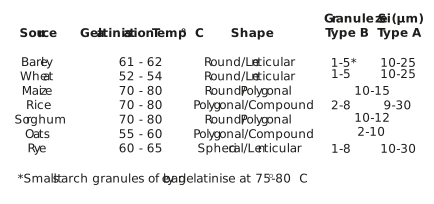
Figure: Cereal gelatinisation temperatures
We can see that for all the cereals in the figure, we have a problem. If we gelatinise the starch granules, we are going above the optimum temperatures for the proteolytic and cytolytic (β-glucan and pentosan degrading) enzymes, and with rice, maize, and sorghum, they will be inactivated. This is the reason why for all but well-modified malt, we need to use more than one temperature for mashing. For everything else, we need to provide stands at different temperatures to allow the enzymes that don’t degrade starch to have their moment to shine.
Cytolysis comes from the Greek words ‘kytos,’ meaning hollow vessel or cell and our old friend lysis meaning to split. Cytolytic enzymes are those that catalyse the hydrolysis of cell wall components β-glucans and pentosans.
The optima of the enzyme of interest are used to give names to the common temperature stands which can be used in mashing. They are:
-
The 45℃ β-glucanase stand
-
The 52℃ protease (proteolytic) stand
-
The 63℃ β-amylase (or saccharification) stand
-
The 72℃ α-amylase (or conversion) stand
-
The 76℃ enzyme inactivation stand, or mash-off
The temperatures above are typical temperatures, and those used in practice may vary from brewery to brewery.
By including the name of the enzyme in the name of the stand, it is tempting to assume that the named enzyme is the only one doing any work. This is completely incorrect. All enzymes that have not reached their inactivation temperature will work to some extent at all temperatures. Those not at their optimum temperature will just be working at sub-optimal rates. In some cases, this sub-optimal rate is still pretty quick!
If we mashed at 20℃ and enzymes weren’t involved, the extract efficiency over a typical mash duration would be 18.5% rather than the 97% we achieve in standard mashes.