
Lesson 4 - The Mashing Process
This lesson discusses the process of mashing. It provides an overview and sets out the objectives of the process before explaining what parameters need to be controlled to ensure success. It describes the various methods used to mash and their impact on the wort produced. Finally, it details the composition of wort produced by mashing.
Wort Composition
What goes in must come out, so wort is made up of what we added during mashing in and later in sparging minus what leaves the process in the spent grains. We should be familiar with a number of the elements of wort composition from our Mashing Biochemistry lesson.
The wort composition for a standard beer (around 11°P) is as follows.
Carbohydrates: 90-92%
Nitrogenous compounds: 3-6%
Lipids: 0.2-1.0%
Polyphenols: 1.5-2.0%
Inorganic material: 1.5-2.9%
Vitamins: 0.05%
The figure below shows the relative proportions as a graph.
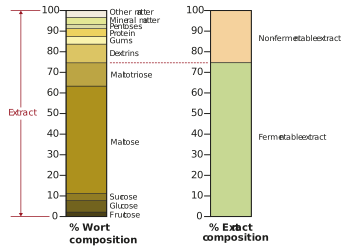
Figure: Proportions of wort composition
This varies according to the mashing regime used and the proportion of adjuncts in the grist. Let’s break these down and explain the components.
Carbohydrates
Wort carbohydrates are mainly the products of starch degradation, with a smaller proportion coming from the breakdown of the pentosans and β-glucans.
A typical wort is around 75% fermentable. The fermentable part of the wort comprises of around:
-
Maltose: 67%
-
Maltotriose: 20%
-
Glucose: 13%
There are also small amounts of fructose and sucrose. As with the overall wort composition the sugar spectrum varies depending on raw materials and mashing conditions.
The non-fermentable part is mostly polysaccharides that are produced from starch and cell wall material during mashing. The rest comes from nitrogenous compounds, lipids, proteins, polyphenols, and inorganic material.
Nitrogenous compounds
The nitrogenous compounds in the wort are those derived from the protein in the malt and adjuncts. Let’s review each type in descending order of size.
-
Proteins – these are very large molecules. They can promote foam stability and are thought to enhance palate fullness. On the negative side, they can cause wort separation and filtration problems and cause haze in the finished beer.
-
Polypeptides – high molecular weight compounds with long chains of amino acids. Like proteins, larger polypeptides can promote foam stability and are thought to enhance palate fullness. Polypeptides are also involved in the formation of haze.
-
Peptides – short-chain sequences of amino acids (2-10 units in length). Smaller peptides can be utilised by yeast. Some feel they can enhance palate fullness.
-
Amino acids – these are the building blocks of proteins. They make up 10-15% of the wort total soluble nitrogen (TSN). As part of FAN, they are essential yeast nutrients. 140 -160 mg/L of FAN is required at the start of fermentation to ensure the yeast can complete the fermentation effectively.
Given the various important roles played by nitrogenous material, it is important that mashing provides the right levels of the right kind of compound. Excessive levels can lead to reduce biological and colloidal stability and cause excessive yeast growth.
Lipids
Most of the lipid material present in our wort is in the form of free fatty acids and sterols. These are important yeast nutrients required for consistent fermentations. This is covered in detail in Module 2 of the course.
Polyphenols
The polyphenol levels in wort are increased at higher pH levels and higher mashing and sparging temperatures. They form trub and haze with polypeptides and are thought to affect the mouthfeel of beer.
Inorganic material
We covered the roles of calcium and phosphate earlier on in the lesson. Several inorganic ions are required by yeast as growth factors, often as enzymic cofactors. These include:
-
Zinc
-
Manganese
-
Calcium
-
Magnesium
-
Sodium
-
Potassium
-
Iron
-
Copper
-
Phosphate
-
Sulphate
Of all these ions, zinc is the one that is not always present in malt at sufficient levels. Many brewers, therefore, add zinc to the wort to support the yeast during fermentation.
Adding zinc is not permitted by the Reinheitsgebot. Some brewers get around this by using zinc components in brewhouse vessels that leach zinc into the wort.
Vitamins
Wort contains several vitamins which are required by yeast for use as enzyme cofactors. They are:
-
Biotin
-
Pantothenate
-
Myo-inositol
-
Thiamine
-
Pyridoxine
-
Niacin