
Lesson 4 - The Mashing Process
This lesson discusses the process of mashing. It provides an overview and sets out the objectives of the process before explaining what parameters need to be controlled to ensure success. It describes the various methods used to mash and their impact on the wort produced. Finally, it details the composition of wort produced by mashing.
Point of Reflection – Reconvene
Welcome back. So, what were your thoughts?
If we remember back to our Mashing Biochemistry lesson, we know that β-glucan consists of chains of β-glucose residues which are cross-linked by proteins. The hydrolysis of the protein cross-links is catalysed by β-glucan solubilase, which has an optimum temperature of 60℃, so it doesn’t work effectively at the low temperature stands typically used for β-glucan degradation. By performing a 62℃ rest before cooling to 45℃, the β-glucan in 45% of the grist gets processed once by β-glucan solubilase and twice by the β-glucanases. The remaining β-glucan gets processed by the β-glucanases for 45 min. This helps prevent the processing and haze problems associated with excessive levels of β-glucans.
Jump mashing
Jump mashing is used in the production of low alcohol and alcohol-free beers. The temperature of the mash jumps from a proteolytic stand at 50℃ to over 70℃, thus minimising the production of fermentable sugars by β-amylase. Here are the steps in the process:
-
A thick mash with a water to grist ratio of 2:1 is mashed in at 50℃ and stands for 20-30 minutes. (this stand is unnecessary if the malt's storage protein is well modified)
-
Boiling water is added to bring the water to grist ratio up to 4.3:1 and the temperature up to around 74℃.
-
The mash is held at this temperature for around an hour before heating and mashing out.
The figure below summarises the jump mashing process.
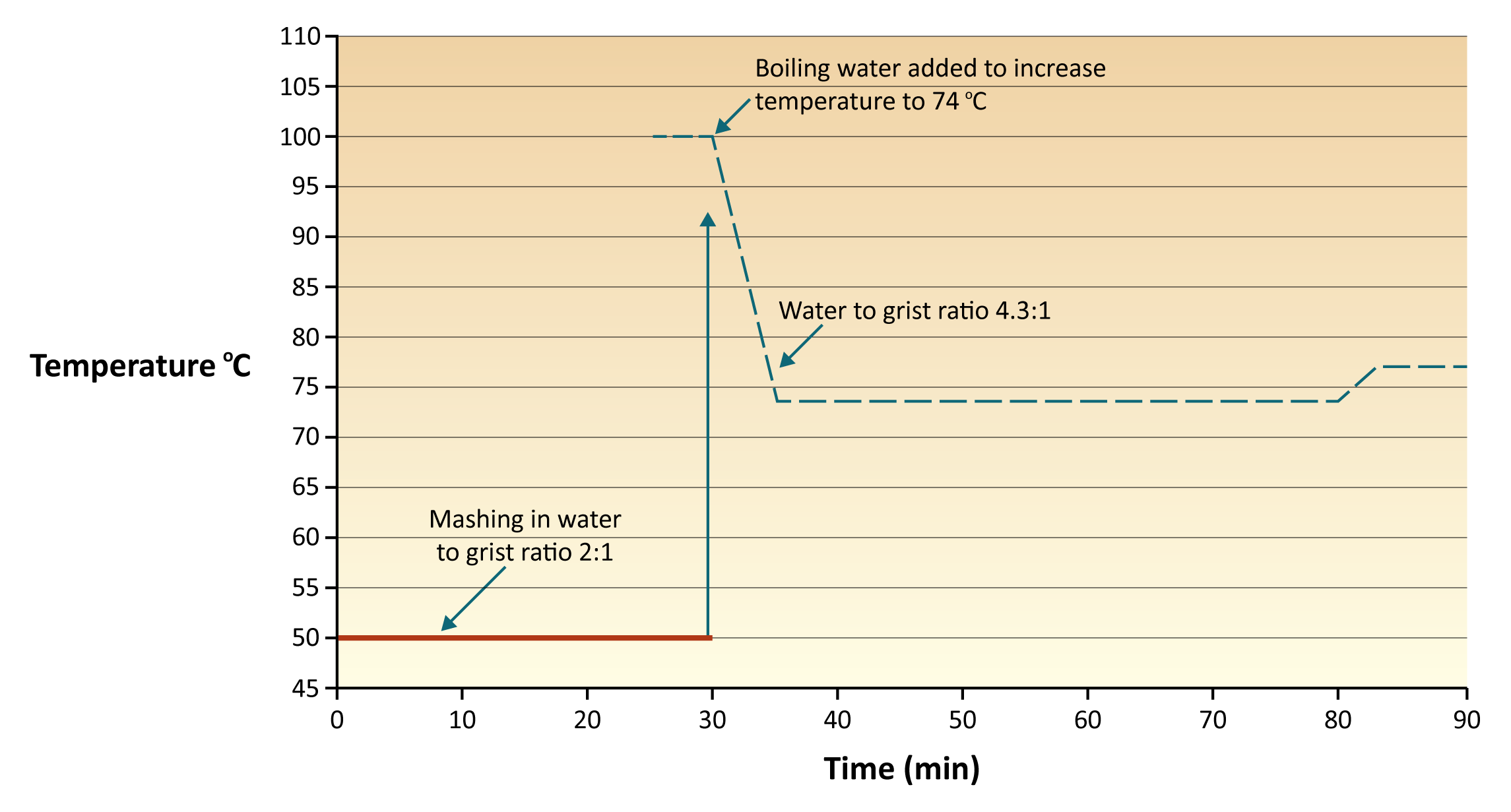
Figure: Jump mashing programme
German brewers have a wonderful word for jump mashing, Springmaischeverfahren. You can picture the temperature jumping like a Bavarian stag in springtime!
Because β-amylase is inactivated, the fermentability of the wort produced by jump mashing is low but should contain enough FAN. If no proteolytic stand is required, mashing in to achieve a temperature of 74℃ produces the same level of fermentability (or lack thereof). In either case, care must be taken not to allow the temperature to fall below 73℃ or the fermentability of the wort will increase. As the conversion temperature of 74℃ is above the optimum for α-amylase, some α-glucans (large dextrins) can remain, and the mash may show a positive in a starch endpoint test. As there is no β-glucan rest, the malt used should be modified to the extent where the majority of β-glucans are degraded.
We have now added a comprehensive review of mashing regimes to our knowledge of mashing parameters. We can now move on to complete the mashing picture by gaining an understanding of the wort it helps to produce.