
Lesson 4 - The Mashing Process
This lesson discusses the process of mashing. It provides an overview and sets out the objectives of the process before explaining what parameters need to be controlled to ensure success. It describes the various methods used to mash and their impact on the wort produced. Finally, it details the composition of wort produced by mashing.
Other Mashing Methods Using Varied Temperatures
In the last section on methods of mashing, we will cover two multi-temperature mashing methods used to produce beers with specific characteristics.
Maltase mashing
Maltase is another name for α-glucosidase, which catalyses the hydrolysis of polysaccharides and maltose to produce glucose. Higher proportions of glucose in wort can lead to the formation of more esters in the finished beer. For some beers, particularly German wheat beers, higher ester concentrations can be desirable. For these, we can use maltase mashing. High glucose concentrations can be achieved by promoting the activity of α-glucosidase. α-Glucosidase is best able to produce glucose in the presence of high concentrations of maltose. The problem is that at its optimum temperature (40℃-45℃), saccharification has not begun, so maltose levels in the mash are low. In maltase mashing, we first saccharify part of the mash and then crash cool it by adding the remainder at a low temperature. Here are the steps.
-
Mash in 45% of the grist with 60% of the mashing water at 62℃ and rest for 40 minutes
-
Heat to 70℃
-
Mash in the remaining grist and cold mashing water to cool the mash to 45℃
-
After a 40 minute rest, the mash is then heated back to saccharification temperature for a stand before mashing off
This is summarised in the figure below:
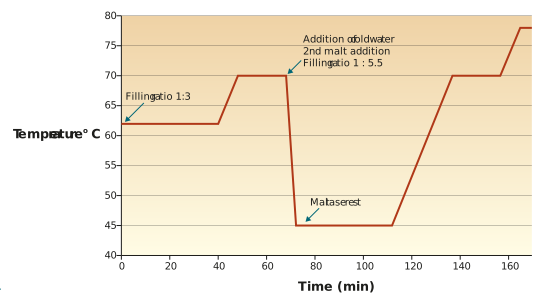
Figure: Maltase mashing programme
The alternative to maltase mashing (if you are able to brew without complying with the Reinheitsgebot) is simply to add the required amount of glucose to the wort before fermentation.
This process is also good for dealing with a malt high in β-glucan. Remembering what we know about the enzymes that break down β-glucan, can you explain why that is?
Give yourself 5-10 minutes to think about this and then click ‘Next’ to continue with this lesson.