
Lesson 4 - The Mashing Process
This lesson discusses the process of mashing. It provides an overview and sets out the objectives of the process before explaining what parameters need to be controlled to ensure success. It describes the various methods used to mash and their impact on the wort produced. Finally, it details the composition of wort produced by mashing.
Double Mashing
Double mashing originated in the USA and was developed to work with adjuncts with higher starch gelatinisation temperatures than the large starch granules of barley. In double mashing, we use a separate vessel (the cereal cooker) to heat a slurry or mash of the adjunct enabling us to gelatinise its starch without denaturing malt enzymes in the main mash.
The cereal cooker is a similar vessel to the MCV in that it has an agitator and a means of heating the adjunct mash. Older cereal cookers, especially those processing rice grits, were able to cook the adjuncts under pressure and hence at a higher temperature. This is unnecessary today as we can specify varieties of cereal that gelatinise more readily, and the cost of the energy required to pressure cook the grains is greater than the benefit in extract recovery.
In double mashing, we carry out parallel mashes of malt and adjuncts before combining them. The rice or maize grits are mashed into the cereal cooker at a water to grits ratio of up to 5:1 (often around 4:1) and around 50℃. Malt and/or heat-stable exogenous ɑ-amylase are added before the cereal is mashed in to help liquefy the starch as it gelatinises. Failing to do this can result in set mashes and jammed agitators. The temperature is then ramped up, and the adjunct mash is boiled. Some programmes incorporate a short stand at around 70℃ to allow ɑ-amylase to work on any available starch. Once boiling commences, the malt grist is mashed into the MCV at around 45℃ to allow proteolysis and cytolysis to proceed (this stand is omitted if well modified malt is used). After boiling for 30-40 minutes, the adjunct mash is pumped to the malt mash causing the temperature to rise to around 65℃ for saccharification. After a saccharification stand, the temperature is raised by heating the MCV to around 70℃ for a conversion stand and then to around 76℃ for mashing off. Exact stand temperatures and timings vary between breweries. A summary of a double mashing programme is provided in the figure below.
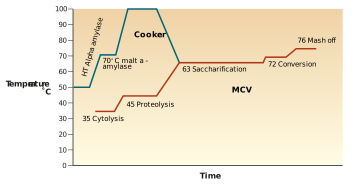
Figure: Double mashing
The alternative to double mashing is to use pre-gelatinised adjuncts. These are a great deal more expensive than grits, so this is unusual where adjuncts are a significant proportion of the grist.