
Lesson 4 - The Mashing Process
This lesson discusses the process of mashing. It provides an overview and sets out the objectives of the process before explaining what parameters need to be controlled to ensure success. It describes the various methods used to mash and their impact on the wort produced. Finally, it details the composition of wort produced by mashing.
Decoction Mashing
Decoction mashing is the oldest form of temperature-programmed mashing. It was developed in Europe to process under modified malts before the days of accurate temperature control. Although still used by some breweries, it is becoming increasingly rare.
In decoction mashing, a portion of the mash is removed from the main mash, heated, and then added back. This results in a temperature increase in the main mash.
In the days before we could accurately measure temperature, we could estimate volume using the heights of mash in the brewhouse vessels. It was more practical to use known fractions of boiling mash to raise the temperature of the main mash than try to estimate how hot it was as we raised its temperature by heating it.
Two vessels are used in decoction mashing. A mash mixer that holds the main mash (and in some cases has the ability to heat it) and a mash kettle that heats the decocted portion. Today both vessels have agitators. There is a range of decoction mashing options, and individual breweries use variations on these themes. To discuss all in depth is beyond the scope of the Diploma in Brewing syllabus, but we will describe one in detail and give a brief explanation of the others.
Triple decoction
For a full description of decoction mashing, we will go with the most complex, triple decoction. The steps are as follows:
-
The mash mixer is filled with warm water, and whilst agitating, the grist is mashed in via a simple hydrator at ambient temperature. At this stage, the water to grist ratio is around 2:1-2.5:1.
-
Hot water at around 95℃ is added to the mash mixer either from the mash kettle (MK) or from a hot water tank. This raises the mash to around 35℃ and achieves the target water to grist ratio of between 3:1 and 5.4:1. Once the mash is homogenous, the agitator is stopped, and the solid material in the mixer drops to the bottom, forming a thick mash.
-
A portion of this thick mash is pumped from the bottom of the mash mixer into the bottom of the mash kettle. One third of the volume in the mixer is transferred at this point. In the mash kettle, the thick mash is heated to 65℃ and held at this temperature for 20 minutes to allow ɑ-amylase and β-amylase to operate close to their optimum temperatures.
-
The thick mash is then heated to boiling over 30 minutes and boiled for between 15 and 45 minutes before being returned to the main mash. The boiling of the thick mash denatures all enzymes but gelatinises starch and helps break down the protein and cell wall material to an extent. The thick mash is used for boiling in order to maximise the amount of solids that are boiled. This also means the enzymes in solution in the thin mash remain unharmed and can operate in the mash mixer while the boil is proceeding. At 35℃, β-glucanase enzymes are most active.
-
Returning the boiled mash to the mash mixer increases the temperature to approximately 50℃. The temperature is low enough to avoid denaturing the proteolytic and cytolytic enzymes and promotes proteolysis. During the 50℃ stand, FAN concentrations increase and the remaining protein matrix and β-glucans are degraded to enable amylases to access the starch granules.
-
Once the mash is fully mixed and the temperature is even, the agitator is stopped, and the mash is allowed to settle again. A portion of the thick mash is then pumped to the MK and brought to the boil over a 30-minute period, whilst the mash remaining in the mixer sustains the 50℃ protein rest.
With all temperature-programmed mashing, the time taken to raise the temperature of the mash is as important as the temperature stands as enzymes are still active until deactivated by the heat. Any change in ramping time will affect mash and wort composition.
7. Following the ramp-up to boil, the mash is boiled for 30 minutes before being pumped back to the main mash. This raises the temperature to 65℃ so as to gelatinise and saccharify the starch.
8. After the recombined mash has settled, a final portion is removed to the mash kettle and ramped up to the boil as before. When transferred back to the mash mixer, the temperature of the main mash reaches the mashing off temperature of 76℃.
The figure below summarises triple decoction showing the enzymes active at each stage.
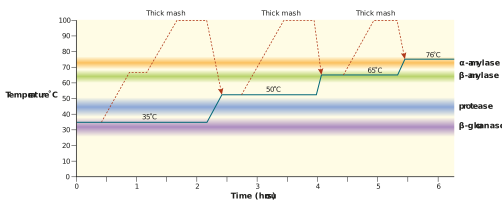
Figure: Triple decoction mashing
There are variations in practice with triple decoction, some use different temperature stands, and some use the thin mash for all but the first decoction.
Other decoction mashes
In double decoction (not to be confused with double mashing), the starting temperature is 45-50℃. Thick mash is removed, heated to boiling for 15-20 minutes before being returned to the main mash producing a temperature of around 65℃. A second thick mash decoction is undertaken, this time boiling for a shorter period before being returned to the main mash. The resulting temperature is 75℃ before mashing off. This is summarised in the figure below.
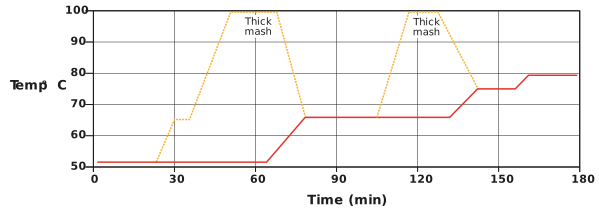
Figure: Double decoction mashing
As we can see from the diagram, the time spent at 45-50℃ is proportionally very long. Therefore, protein breakdown can be excessive, leading to reduced foam stability and beer with a thin palate. A shortened version of double decoction where there is no stand at 45-50℃ but stands at 62℃ and 75℃ can also be used. This avoids the excessive proteolysis but requires relatively well-modified malt as there is no stand for cytolysis.
For single decoction mashing, we need to be able to heat both the mash mixer and the mash kettle. The single decoction can either increase the temperature from 50℃ to 65℃ or from 65℃ to 70℃. Other temperature changes are undertaken in the MCV.
We can calculate the volume of boiled mash required to achieve a target temperature using the following calculation.

We use 95℃ instead of 100℃ as some cooling occurs during pumping and mixing.
Decoction mashing is still favoured by some breweries who feel that it is essential for the flavour of their beer. It is also used as a unique selling point (USP) by some modern craft breweries. It can provide enhanced extract recovery (over isothermal mashing), improved foam stability and removal of dimethyl sulphide. However, it uses the most vessels of all the mashing regimes, takes a long time (six hours in the case of triple decoction) and, due to the need to boil mash, is very expensive and energy intensive. Decoction mashing can require 20-50% more energy than the other mashing methods. Single-vessel programmed mashing uses roughly 8.5 MJ/hL of wort, while single decoction uses 11.0 MJ/hL, and double decoction uses 11.6 MJ/hL. These figures will vary depending on the programme used and the design of the brewhouse. Boiling part of the mash also increases the colour of the resultant wort and extracts polyphenols to a greater extent than other forms of mashing.