
Lesson 4 - Milling Principles
This lesson explains the objectives of milling and how mills are designed to achieve them. It details how malt is conditioned for dry milling and how we analyse grist particle size profiles. Finally, it explains how milling affects downstream brewing processes.
Grist Analysis
As with every task we complete in the brewing process, we need to be able to check the output of milling to ensure we have achieved the desired outcome. For dry milling, this is done using a plansifter.
We discovered the plansifter in the Malt Intake and Storage lesson. For grist, we use different sieves with smaller mesh sizes to test the grain. Three industry standards are used. The mesh sizes and names given to the grist fractions held by each are shown in the tables below.
Table: The five sieves of the EBC Pfungstadt analysis
|
Sieve |
Mesh Width (mm) |
Fraction name |
|
1 |
1.27 |
Husk |
|
2 |
1.01 |
Coarse grits |
|
3 |
0.547 |
Fine grits I |
|
4 |
0.253 |
Fine grits II |
|
5 |
0.152 |
Flour |
|
Base |
Fine flour |
Table: The six sieves of the ASBC analysis
|
Sieve |
Mesh Width (mm) |
Fraction Name |
|
1 |
2 |
Husk |
|
2 |
1.4 |
Husk |
|
3 |
0.5 |
Husk |
|
4 |
0.25 |
Coarse grits |
|
5 |
0.18 |
Fine grits |
|
6 |
0.15 |
Flour |
|
Base |
Fine flour |
Table: The five sieves of the MEBAK analysis
|
Sieve |
Mesh width (mm) |
Fraction Name |
|
1 |
1.25 |
- |
|
2 |
1.0 |
- |
|
3 |
0.5 |
- |
|
4 |
0.25 |
- |
|
5 |
0.125 |
- |
|
Base |
- |
It is important to note that the names given to the fractions held by each mesh size do not accurately reflect what is held. For example, the coarse grits sieve in the EBC Pfungstadt analysis would have a lot of husk material in it and not just endosperm grits.
The dictionary definition of grits is coarsely ground hulled cereal. In brewing, it means something similar − small and medium sized chunks of endosperm.
In the plansifter analysis, 100 g or 200 g of grist is added to the top sieve and the plansifter is set to shake the sample for one min. The sieves are then separated and the amount of grist in each sieve is weighed. The analysis is undertaken regularly to monitor mill performance. There is a recommended grist particle size profile for each of the wort separation systems and those based on the five sieves of the EBC Pfungstadt analysis are shown below.
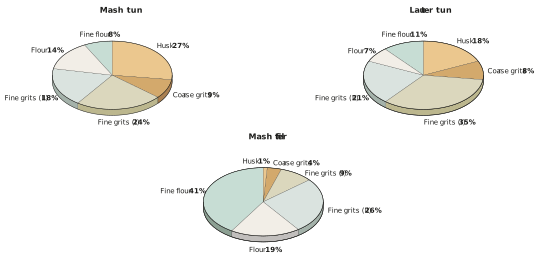
Figure: Recommended grist for the three main wort separation technologies
These recommended grist profiles are only a guide to the most appropriate proportions for each type of wort separation system. Most breweries will have a specification for their grist based on their own wort separation performance data.
It is only possible to undertake this analysis on dry milled grist. The grist from wet mills is, in effect, mash and therefore will not fall easily through the mesh. For wet milled grist, a visual examination is undertaken to estimate the size of the husk particles.
Point of reflection: What effect is the degree of malt modification likely to have on the results of plansifter analysis?
Give yourself 5-10 min to think about this, and then click ‘Next’ to continue with this lesson.