
Lesson 4 - Milling Principles
This lesson explains the objectives of milling and how mills are designed to achieve them. It details how malt is conditioned for dry milling and how we analyse grist particle size profiles. Finally, it explains how milling affects downstream brewing processes.
Malt Conditioning
Malt conditioning links back to our second milling objective, the requirement to retain the required level of husk integrity. It enables us to do this without sacrificing extract efficiency.
Malt husks with a moisture level of around 4% are very brittle. This means the more you mill grain, the more the husk shatters into small particles. If we use mash tuns and lauter tuns, this means the gaps in our filter are much smaller and wort separation is slower. Think of the difference between a coffee filter paper and a sieve. Liquid flows through a sieve much more freely than a filter paper. In malt conditioning, we moisten the husk, making it more pliable. This means we can mill the malt more thoroughly without reducing the size of the husk fragments to the point where wort separation is slowed.
Malt conditioning can be undertaken using three technologies: the malt conditioning screw (Buhler Condimat); the steep conditioned wet mill; and the full steep wet mill. We will cover steep conditioned wet mills and full steep wet mills in the Milling Technology lesson.
In conditioning screws, the malt is fed into a slow running screw conveyor and sprayed with water or flushed with steam. Older versions of malt conditioning screws used steam at 0.5 bar for 30-60 s before a 90-120 s hydration period, while modern ones use warm water, typically at 35°C for one-minute hydration time. After spraying, the malt and water both move through a section containing mixing paddles for hydration. Conditioning screws using steam can increase the total malt moisture by 1.2-1.5% while those using water increase it by 2.0-2.5%. They increase grist volumes from 500-700 mL/100 g of malt, to 700-1,000 mL/100 g malt. As the overall moisture content is increased by a maximum of 2.5%, the grist can be fed to a standard grist case after milling. A control system maintains the correct flow rates of the malt water/steam and feed to the mill. The advantages of conditioning malt in this way are said to be:
-
The increase in husk elasticity allows more thorough milling (tighter mill gaps) without a reduction in husk size.
-
The volume of husk available for lautering increases by 10-20%, so wort separation is faster.
-
Extract efficiency is improved.
-
Saccharification is achieved more rapidly, so mashing takes less time.
-
With less damage to acrospire, flavour stability can be increased.
The disadvantages are:
-
There is more equipment to operate and maintain.
-
Dust needs to be minimised in the malt feed.
-
Conditioning screw and mill require more cleaning than standard dry mills.
-
Not suited to all roller mills.
The figure below shows a conditioning screw.
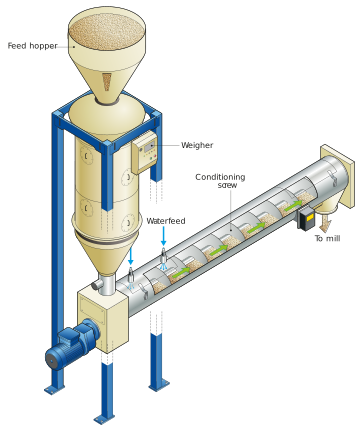
Figure: Conditioning screw
Conditioning screws are designed to work with specific types of dry mill. The screws are constructed of stainless steel because the conditions in the screw can cause corrosion in other steel grades. The last of the malt leaving the screw is not conditioned to reduce the amount of material accumulating in the screw. However, it is still recommended that the screw is cleaned on a weekly basis.