
Lesson 12 - Utilities Part 2 End of Unit SAQ
This lesson allows you to test yourself on the material covered in the Utilities Part 2 unit and determine the level to which you have met the learning outcomes.
Suggested Response - Q4
***
a) In one month, your brewery fermented 100 brews of 500 hL brewlength. Each brew had a fermentable range from 16 °Plato (1065.4 kg/m3) to a real extract of 1°Plato (1003.9 kg/m3). If your CO2 recovery plant operates with a 50% overall collection efficiency, how much CO2 would you have collected into storage?
b) Describe the various approaches, and plant as appropriate, for reducing oxygen levels throughout a typical CO2 recovery plant.
Response:
a) This is a comparatively straightforward application of the idealised CO2 yield figure of 0.49 kg CO2 per kg of sugar fermented.
The idealised total quantity of CO2 produced would be given by:

At an OG of 16°P, wort has a density of 1065.4 kg/m3, so 1m3 of wort weighs 1065.4 kg
16°P wort is 16% w/w sugar so 1m3 contains 16/100 x 1065.4 = 170.464 kg of sugar
At an FG (real attenuation)of 1°P, wort density is 1003.9 kg/m3 so 1m3 of wort weighs 1003.9 kg
1°P wort is 1% w/w sugar so 1m3 contains 1/100 x 1003.9 = 10.039 kg of sugar
So the mass of sugar fermented is 170.464 – 10.039 = 160.425 kg
Since for every 1kg of sugar fermented we get 0.49kg of CO2,the CO2 evolved = 160.425 x 0.49 = 78.608 kg
If 1m3 of wort at 16°P yields 78.608 kg, then 5000 m3 (100 x 500hl) would yield 5000 x 78.608 = 393,041 kg
Remember that the overall collection efficiency of the recovery plant is the ratio of the mass of purified CO2 collected into storage to the idealised quantity produced:

Rearranging for the mass purified and put into storage:


b) It is important to remember that oxygen is present in the CO2 raw gas initially in the form of air which remains in the fermenter after cleaning. There are various ways to reduce oxygen levels throughout a typical CO2 recovery plant.
The first approach to reduce oxygen in the recovery process is to vent to atmosphere the initial CO2 raw gas that exits the fermenter once fermentation starts. This raw gas contains high levels of oxygen, which reduces with time as the fermentation progresses.
Differing approaches are available to decide when to switch from venting the raw gas to collecting it. These include:
-
Time-based – the decision to switch from venting the raw gas to collecting it is made with reference to an elapsed duration of time. This is typically taken from the moment that filling of the fermenter has been completed, at which point the fermenter is put on vent, until the time that the fermenter is put on collection. This allows for sufficient fermentation activity, and hence sufficient carbon dioxide produced, to have purged the air out of the headspace so that the oxygen level is low enough. A four- to six-hour venting duration is typical.
-
Oxygen measurement – explicit measurement of the oxygen content of the raw gas can be used to trigger the vent-to-collect decision. Two locations can be used:
-
At the bung line of each fermenter
-
Within the collection main itself
-
-
Foam trap – arguably an initial reduction of oxygen in the raw gas would take place in the foam trap, but as small quantities of water are used to entrap the foam, the water is likely to become saturated with oxygen very quickly and thereafter no oxygen reduction would take place
-
Washing (scrubber) – the absorption process is intended to capture water-soluble components in the raw gas, but as a secondary it would also scrub (remove) some oxygen from the raw gas
-
Condenser – oxygen present with the CO2 raw gas will not condense at the typical temperatures (-30°C) used in the condenser, and they will remain as gases when the CO2 condenses as a liquid and can be vented out of the condenser. This is a simple form of phase separation, i.e. within the condenser we separate the incondensable O2 gas phase from the CO2 liquid phase, so the liquid CO2 stream will then be less in O2 than the incoming CO2 gas stream. This is shown in the figure below:
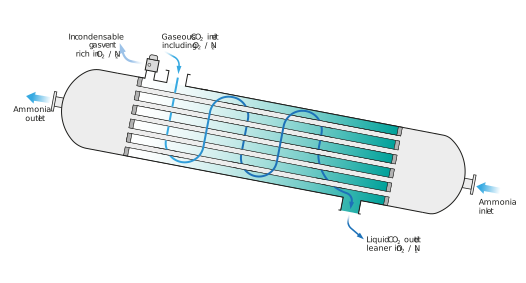
Figure: Condenser, showing the purification of the liquid CO2 stream
- Stripper – with a solution of CO2 and O2, pure CO2 has a higher boiling point (250 K at 18 bar) than pure O2 (130 K at 18 bar). So, when it boils, the first vapour formed will be richer in O2 and conversely the remaining boiling liquid mixture will be leaner in O2, i.e. we will have reduced the dissolved oxygen in the boiling liquid by ‘boiling off’ some of the oxygen.
A simplified schematic for this process is shown in the figure below.
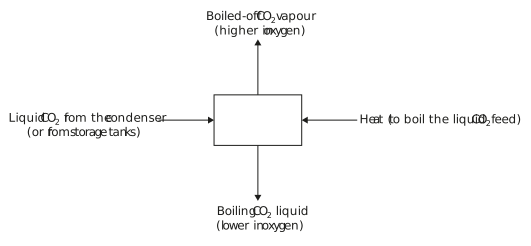
Figure: The purification of impure liquid CO2 by boiling
There are two streams coming from the boiling process: a vapour stream which is higher in oxygen, and a liquid stream which is lower in oxygen.
If we consider 10 or more theoretical distillation processes stacked on top of each other in a single column, and include a single input of heat at the bottom of the column and a single exit of oxygen-rich gaseous CO2 at the top of the column, then a high level of CO2 purification via distillation will result. See the figure below.
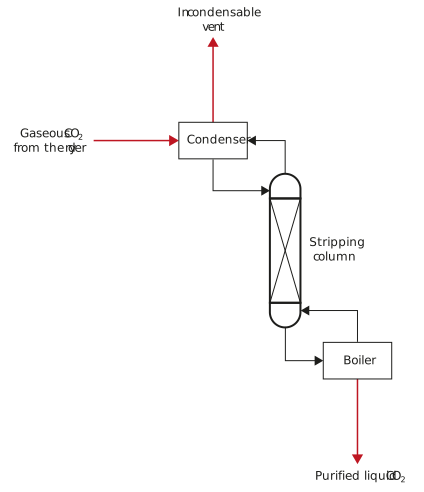
Figure: A simplified CO2 stripper unit