
Lesson 10 - Utilities Part 1 End of Unit SAQ
This lesson allows you to test yourself on the material covered in the Utilities Part 1 unit and determine the level to which you have met the learning outcomes.
Suggested Response - Q1
*** A boiler is operating at 900 kPa. It produces saturated steam. The steam lines are long, so the steam loses 5% of its energy by the time it reaches the pressure reducing station. The pressure reducing station reduces the pressure to 200 kPa. From the pressure reducing station, the steam then supplies a heat exchanger at 200 kPa. The condensate leaving the heat exchanger is taken to an atmospheric condensate system.
a) Using a Mollier diagram, indicate the following on the diagram:
i. A – The steam leaving the boiler
ii. B – The steam entering the pressure reducing station (before the removal of condensate)
iii. C – The steam entering the pressure reducing valve
iv. D – The steam just after the pressure reducing valve
v. E – The condensate leaving the heat exchanger
vi. F – The condensate at the atmospheric condensate tank just before it flashes
vii. G – The condensate after flashing has occurred
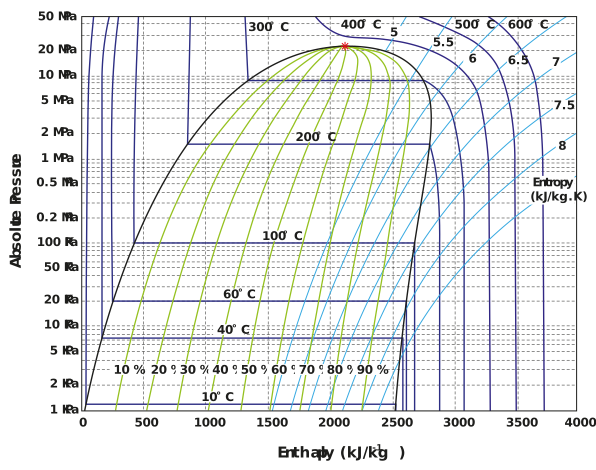
Figure: Mollier diagram for water
b) What is the state of the steam at each of the points in a)?
c) Calculate how much condensate (as a percentage of total steam) will be drained before the pressure reducing station. Assume that you have 100% separation of vapour and liquid. Also assume that there are no pressure losses in the steam line (although we know that is not possible).
d) To what temperature will the steam be superheated after the pressure is reduced if the specific heat of vapour (sg) is 7.7014 kJ kg-1 K-1?
e) How much energy is available to perform heating in the heat exchanger?
f) Calculate the amount of condensate that will flash off in the condensate tank.
g) If the heat exchanger requires 1,000 kg of steam per hour, and the boiler feed water temperature is 20°C, what is the required gas flow rate for the boiler if it has an 80% boiler efficiency and the calorific value of the gas is 44 MJ/kg? Remember to take into account the condensate drained from the before the pressure reducing station calculated in (c) above. For the purposes of this calculation, assume there is no flash steam from this condensate draining point. Also take into account the condensate flash losses calculated in (f) above.
Assume condensate is returned to the boiler at 100°C.
Steam table information for SAQ 1 is as follows:
Table: Saturation temperature table for steam in SI units
|
T |
Psat |
hf |
hg |
hfg |
|
°C |
kPa |
kJkg-1 |
kJkg-1 |
kJkg-1 |
|
0 |
0.6119 |
0.9007 |
2,500.02 |
2,499.12 |
|
10 |
1.2282 |
42.2477 |
2,520.42 |
2,477.27 |
|
20 |
2.3376 |
84.2043 |
2,538.85 |
2,454.65 |
|
30 |
4.242 |
125.811 |
2,556.81 |
2,431 |
|
40 |
7.3743 |
167.452 |
2,574.65 |
2,407.2 |
|
50 |
12.333 |
209.15 |
2,592.34 |
2,383.19 |
|
60 |
19.916 |
250.918 |
2,609.8 |
2,358.89 |
|
70 |
31.156 |
292.765 |
2,626.94 |
2,334.18 |
|
80 |
47.353 |
334.696 |
2,643.69 |
2,303.9 |
|
90 |
70.104 |
376.72 |
2,660.01 |
2,283.29 |
|
100 |
101.325 |
418.849 |
2,675.84 |
2,256.99 |
|
110 |
143.273 |
461.099 |
2,691.14 |
2,230.04 |
Table: Saturation pressure table for steam in SI units
|
P |
Tsat |
hf |
hg |
hfg |
|
kPa |
°C |
kJkg-1 |
kJkg-1 |
kJkg-1 |
|
100 |
99.63 |
417.31 |
2,675.27 |
2,257.96 |
|
200 |
120.23 |
504.47 |
2,706.17 |
2,291.7 |
|
300 |
133.54 |
561.16 |
2,724.63 |
2,163.47 |
|
400 |
143.62 |
604.37 |
2,737.68 |
2,133.31 |
|
500 |
151.84 |
639.79 |
2,747.64 |
2,107.86 |
|
600 |
158.83 |
670.07 |
2,755.6 |
2,085.52 |
|
700 |
164.95 |
696.7 |
2,762.13 |
2,065.43 |
|
800 |
170.4 |
720.57 |
2,767.61 |
2,047.05 |
|
900 |
175.35 |
742.27 |
2,772.27 |
2,030 |
|
1000 |
179.87 |
762.23 |
2,776.28 |
2,014.05 |
|
1250 |
189.8 |
806.32 |
2,784.16 |
1,977.84 |
|
1500 |
198.28 |
844.32 |
2,789.84 |
1,945.52 |
Please note:
hf is the specific enthalpy of the water
hfg is the specific enthalpy of evaporation
hg is the specific enthalpy of steam
Response:
a)
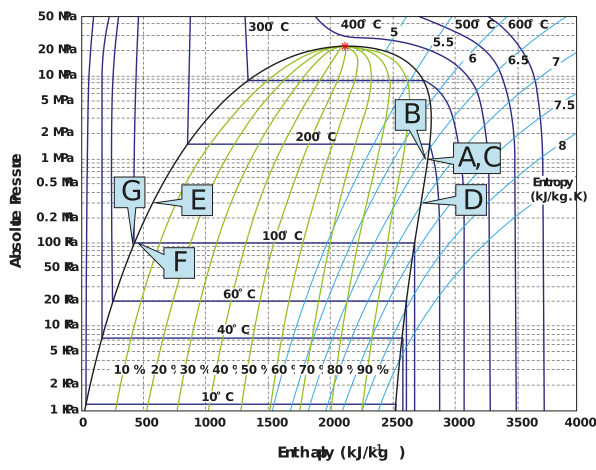
Figure: Mollier diagram for water
b) A – Saturated vapour at 1 MPa a (900 kPa g) and 179.9°C
B – Wet steam at 1MPa a (900 kPa g) and 179.9°C
Both condensate and vapour are present
93.1% dryness
C – Saturated vapour at 1MPa a (900 kPa g) and 179.9°C
D – Superheated steam at 300 kPa a (200 kPa g) and T > 133°C
E – Saturated liquid at 300 kPa a (200 kPa g) and 133°C
F – Wet steam at 101.325 kPa a (0 kPa g) and 100°C
G – Saturated liquid at 101.325 kPa a (0 kPa g) and 100°C
c) The enthalpy of saturated steam at 1 MPa a is:

If 5% losses occur, the enthalpy at point B will be:

Thus, this is now wet steam at 1 MPa a.
Reading from the Mollier diagram for 1 MPa a and 2,637.47 kJ kg-1, we have a dryness fraction (x) of 0.93.
Alternatively, if x is the fraction of the steam vapour in the water/steam mixture, we can calculate the following:


Therefore, under these conditions 6.9% (100-93.1%) of the steam by weight will be drained as condensate before the pressure reducing station.
d) The vapour at 300 kPa a will still have an enthalpy of 2,776.28 kJ kg-1.
From the steam tables, using interpolation at 300 kPa a, the saturated vapour enthalpy of steam is 2,724.63 kJ kg-1, and the saturation temperature is 133.54°C.
The enthalpy change in superheating the steam is thus:

The specific heat of the vapour (sg) = 7.7014 kJ kg-1 K-1.
Therefore, the temperature increase from this change in enthalpy is:

And so the temperature of the superheated steam is calculated as:

e) The energy available for heating consists of the sensible heat in the steam, resulting from the superheat and the latent heat.
The condensate leaving the heat exchanger will be saturated liquid at 300 kPa a.
By looking up the value from the steam table, under these conditions Hl 561.16 kJ kg-1.
Therefore, the energy available

f) The condensate leaving the heat exchanger is saturated liquid at 300 kPa a. To calculate how much flashing occurs, we need to consider the values for 101.325 kPa (atmospheric pressure) and 100°C.


If  is the fraction of flash steam that is generated:


Therefore, 6.3% of the condensate will flash off.
g) If the heat exchanger requires 1,000 kg hr-1, then the boiler must produce more steam to cater for the condensate drainage prior to the pressure reducing station. As 6.9% is drained, the boiler must therefore produce:

To calculate the amount of condensate returned:
We have 74 kg from prior to the pressure reducing station and 937 kg from the heat exchanger. The value 937 kg is calculated by subtracting 6.3% (the amount of condensate that flashes off) from 1,000 kg (1,000 – 63 = 937 kg). Therefore, the total condensate returned is

The makeup water requirement is:

First, let’s calculate the energy required to heat the makeup water to 100°C:


Now, let’s calculate the energy required to generate saturated steam from saturated water at 1 MPa a.


Therefore, the total rate of energy required (q) to heat up the make up water is:

If the boiler has an 80% efficiency then the energy rate required from the fuel will be:

And so
