
Lesson 7 - Refrigeration Theory and Cycle SAQ
This lesson allows you to test yourself on the material covered in the Refrigeration Cycle and Theory lesson and determine the level to which you have met the learning outcomes.
Suggested Response - Q4
*
a) Discuss the relationship between the temperature, the pressure, and the boiling point of a primary refrigerant.
b) Which parts of the OVC cycle operate at a higher pressure? Why?
c) Which parts of the OVC cycle operate at a lower pressure? Why?
Response:
a) A boiling point curve in the illustration below shows the relationship between temperature, pressure, and the boiling point for ammonia (a primary refrigerant). As the pressure is increased, the temperature of the boiling point increases. As the pressure is decreased, the temperature of the boiling point decreases.
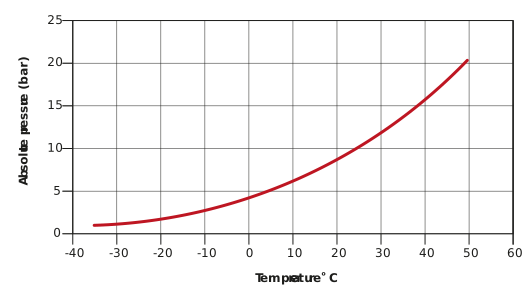
Figure: Temperature-pressure equilibrium curve for ammonia
b) The compressor increases the pressure of the saturated vapour. In doing so, the refrigerant is superheated as it goes into the condenser. The higher pressure results in a higher specific enthalpy.
c) The expansion valve decreases the pressure of the saturated liquid. In doing so, the refrigerant decreases in temperature, preferably to a sub-cooled liquid. The decrease in pressure prepares the refrigerant to accept heat from the heat source.
The figure below visually demonstrates this process.
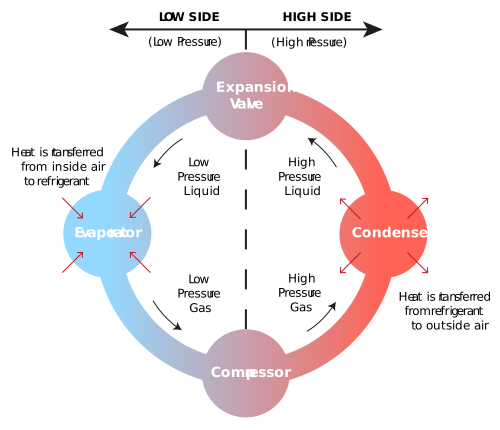
Figure: Refrigeration cycle