
Lesson 7 - Refrigeration Theory and Cycle SAQ
This lesson allows you to test yourself on the material covered in the Refrigeration Cycle and Theory lesson and determine the level to which you have met the learning outcomes.
Self-Assessment Questions
1. *
a) Describe what a refrigerant is.
b) Differentiate between primary, secondary, and tertiary refrigerants.
c) You have a household fridge in your kitchen that uses isobutane to cool the beer in your fridge. Describe the refrigerants that are used in the refrigeration system, and determine whether they are primary, secondary, or tertiary.
2. *
a) What is the vapour compression cycle?
b) Describe the components of the OVC cycle, and state the purpose of each one.
c) Using specific enthalpy, discuss what each component does to the primary refrigerant in the OVC cycle.
3. ** Using the Mollier diagram below, answer the following questions.
Consider a refrigeration process that operates between 15 bar a and 2 bar a. The condenser condenses the refrigerant to a saturated liquid.
a) What is the cooling load?
b) What is the COP of the refrigeration process?
c) How might you enhance the COP of the refrigeration plant?
d) If this refrigeration process was actually a heat pumping process, what would the COP be?
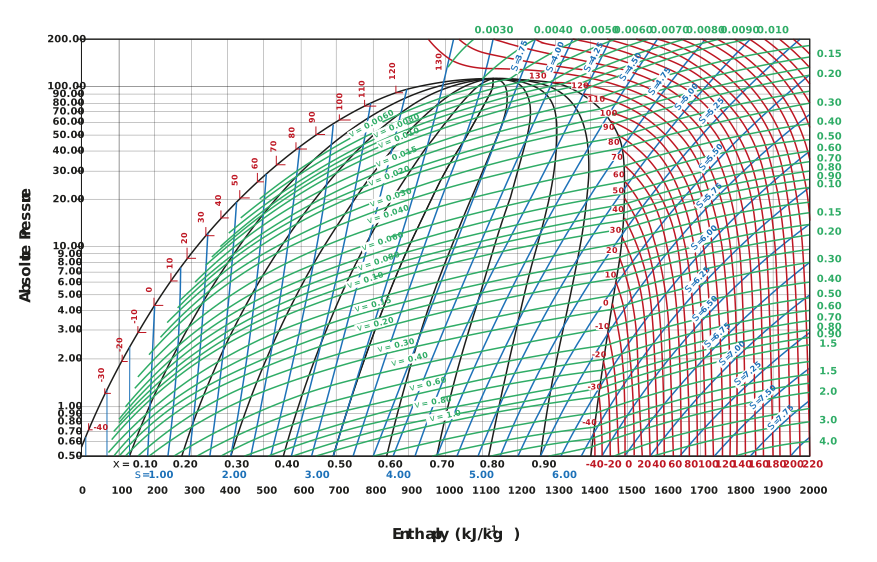
Figure: Mollier diagram for ammonia
4. *
a) Discuss the relationship between the temperature, the pressure, and the boiling point of a primary refrigerant.
b) Which parts of the OVC cycle operate at a higher pressure? Why?
c) Which parts of the OVC cycle operate at a lower pressure? Why?