
Lesson 4 - Convection
This lesson deals with the principles and application of a form of heat transfer called convection. More specifically, it describes the heat transfer mechanisms that involve convection and calculation methods for heat transfer rates determined by convection and phase changes.
Heat Transfer from Condensing Liquids
Condensation of vapours occurs on the surface of tubes cooler than the condensing temperature of the vapour. A vapour may condense on a cold surface in one of two ways: film and dropwise.
Film condensation is more common than dropwise. Consider condensation on the outside of a cool tube. In film condensation, the liquid condensate forms a continuous layer of liquid that flows over the surface of the tube due to gravity. Film condensation occurs readily on smooth surfaces which allow for a continuous stream of liquid. The magnitude of the heat transfer coefficient for film condensation is dependent on the thickness of the layer of liquid between the condensing vapour and the wall of the tube.
In dropwise condensation, the condensate forms at nucleation sites similar to the nucleation sites discussed during boiling. It most commonly occurs on rough surfaces. In dropwise condensation, droplets form but do not form a layer as readily as in film condensation.
The figure below shows these two types of condensation.
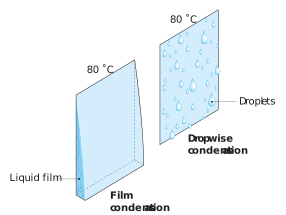
Figure: Film versus dropwise condensation
The average film heat transfer coefficient for dropwise condensation is 5-10 times that for film condensation. This is important when considering condensation of steam for heating purposes throughout the brewery.
A typical value for the convective film heat transfer coefficient for condensing steam is around 5,000 Wm-2K-1.
When a vapour contains a non-condensing gas, the rate of condensation is dramatically reduced. The non-condensable components act as a layer of inhibition, as the condensable molecules now have to diffuse through the layer of non-condensable molecules before reaching the condensation surface.
This is very important for steam condensation in a breweries boiler system. Even just 1% of air in steam can reduce the condensation rate by 50%.