
Lesson 4 - Convection
This lesson deals with the principles and application of a form of heat transfer called convection. More specifically, it describes the heat transfer mechanisms that involve convection and calculation methods for heat transfer rates determined by convection and phase changes.
Boiling and Condensation Heat Transfer
Now we have described how convection occurs, there is one last important point to make about convection. The latent heat absorbed or released during a phase change is commonly used in heat transfer processes. Heat transfer involving phase change is more complicated than simple heat exchange between fluids.
A phase change involves a large amount of heat absorbed or released at constant temperature.
Heat transfer to boiling liquids
Heat transfer to boiling liquids is a required step in evaporation and steam generation. There are two main types of boiling we will discuss: pool and forced-convective boiling. Both types of boiling involve what is called ‘nucleate’ boiling, which we will discuss later in this section.
Pool boiling occurs when boiling is caused by heat transfer from a submerged hot surface.
Forced-convective boiling occurs when a fluid is pumped through a heated channel.
An example of pool boiling is a pot of boiling water on the stove. Visually, bubbles of water vapour can be seen on the bottom of the pot. As the bubbles detach, they rise through the rest of the water and leave through the surface of the water. The previously described internal calandria is also an example of pool boiling.
An example of forced-convective boiling is an external calandria. A calandria is essentially a bundle of tubes heated by steam that heats the wort. Wort is pumped out of the kettle up through the calandria and back into the kettle. We will see later why this is a much more energy efficient operation.
Now that we understand the difference, let’s take a deeper look at these types of boiling and how exactly heat transfer is occurring.
When boiling occurs on a solid surface, bubbles can be seen forming repeatedly at different spots on the surface known as nucleation sites. When a bubble is formed, it detaches from the surface and begins to travel upwards under buoyancy force. When the temperature of the bulk liquid is not at boiling point, the bubble will meet a cooler area, collapse, and condense back to liquid. As a result, the heat of vaporisation lost is transferred to the liquid, which aids heating the bulk liquid. The movement of the bubbles away from the surface causes turbulence and aids in heat transfer. This is called nucleate or nucleation boiling.
Bubbles continue to form at localised sites, usually small pits or scratches on the heating surface. As the surface temperature increases, more nucleation sites become active. Eventually, there can be so many bubbles present that they combine and cover bigger portions of the heating surface. As the temperature of the heating surface increases to roughly 40°C above the liquid temperature, the entire heat surface becomes covered with a thin film of vapour and film boiling occurs. This film of vapour acts as insulation between the heating surface and the fluid, which decreases the heat transfer rate. Film boiling is not desired in commercial equipment because of the decrease in heat transfer rate.
This drastic change in the heat transfer rate is seen in the change in film heat transfer coefficient for the boiling process. When the temperature difference between the heating surface and the boiling liquid reaches a certain point, we have maximum heat transfer. After this maximum, the heat transfer loses efficiency. This can be seen visually in the figure below.
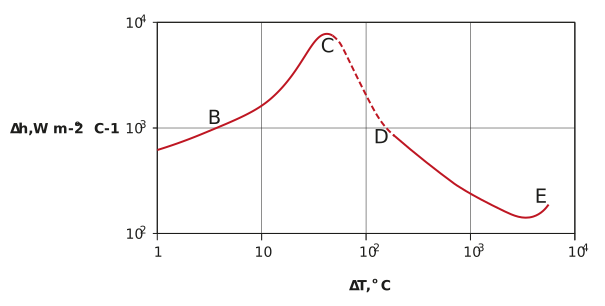
Figure: Heat transfer coefficient as a function of temperature difference of surface and boiling water
The more effective type of boiling, nucleate boiling, depends mostly on how easily the bubbles form and free themselves from the heating surface. An easily wetted surface like copper allows bubbles to be released more easily than a less easily wetted surface like stainless steel. There is more attraction between the liquid and the surface with copper, so the liquid can displace the vapour bubbles more easily. The figure below illustrates the concept of wettability.
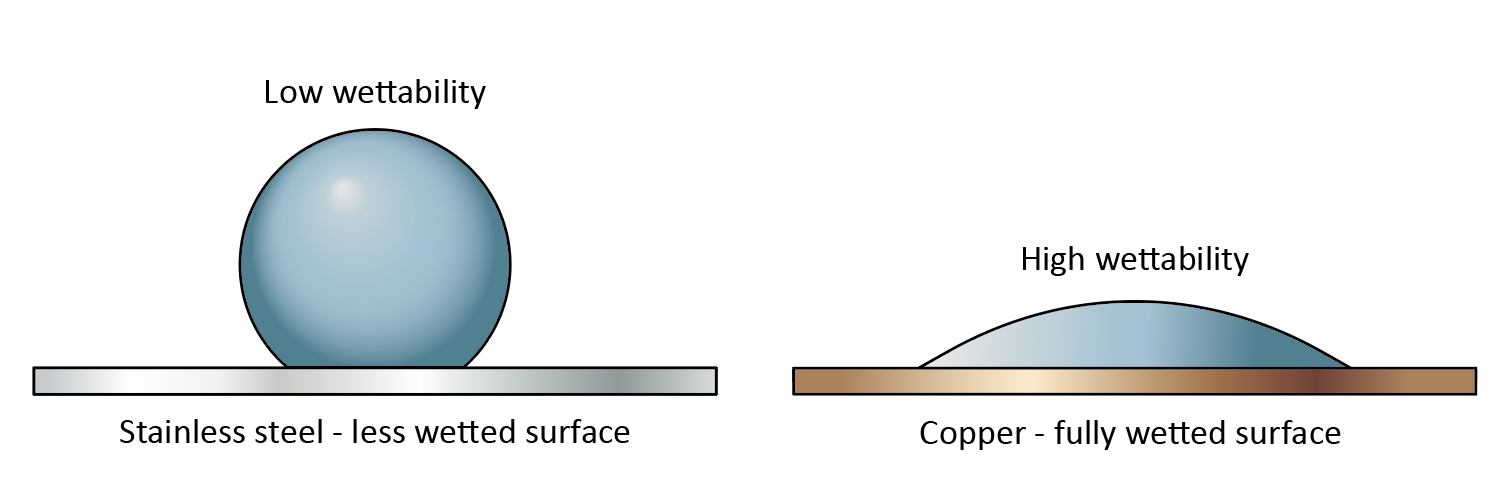
Figure: Fully wetted and less wetted surfaces
Forced convective boiling as seen in external wort kettle calandrias is often the most effective method of evaporation.
During forced convection boiling in a wort kettle calandria, wort is pumped through the insides of heated tubes. These tubes provide a large surface area for bubbles to nucleate. Above the tubes, wort is piped to a wort deflector situated in the centre of the kettle headspace. The deflector spreads the wort evenly over the surface, maximising the contact between the liquid and gas phase of the boiling wort and optimising the evaporation of unwanted volatiles. In doing so, a lower steam pressure can be used, resulting in a less vigorous boil.
A typical value for the convective film heat transfer coefficient for boiling water is 3,000-10,000 W/m2.
Next, we take a closer look at the energy associated with condensation of gas into a liquid.