
Lesson 4 - Convection
This lesson deals with the principles and application of a form of heat transfer called convection. More specifically, it describes the heat transfer mechanisms that involve convection and calculation methods for heat transfer rates determined by convection and phase changes.
Natural Convection
Now that we understand the relationship between conduction and convection, let’s move on to discuss the two main types of convection: natural and forced.
Recall that natural convection occurs naturally, while forced convection requires an outside force like a fan or pump.
Natural convection
Natural convection of a fluid is the result of temperature differences within the fluid.
Recall that as a fluid is heated it expands and becomes less dense. The result of this is the fluid becomes more buoyant. As the fluid is less dense and more buoyant, it will move upward in a room or vessel, replacing the cooler fluid. The movement of the fluid causes a circulating pattern known as natural convection.
A common example of natural convection is heat loss by humans. We lose 10-15% of body heat by convection. The human body’s normal temperature is roughly 37°C, which is higher than the air in an average home of about 21°C. The difference in temperature results in convection on the skin of the human body. The mechanism cannot be seen with the naked eye, but heat is constantly being transferred to the air surrounding the skin in these conditions. The warmer air leaves the area next to the skin and is replaced by cooler air which is subsequently heated. Have you ever walked into a changing room after an athletic event? It is not only stinky, but it is warmer due to the heat given off by all the warm bodies in the room.
A common brewery example of convection is demonstrated when cooling beer inside a fermenter. The fermenter has cooling jackets which enable the cooling of the beer inside the fermenter. The beer closest to the wall of the fermenter will become colder, which increases the density of the beer in that area. The increase in density causes the cooler beer to move towards the bottom of the vessel. The beer further away from the cooling jackets is warmer and less dense and will replace the cooler beer. This naturally occurring circular pattern can be seen in the figure below.
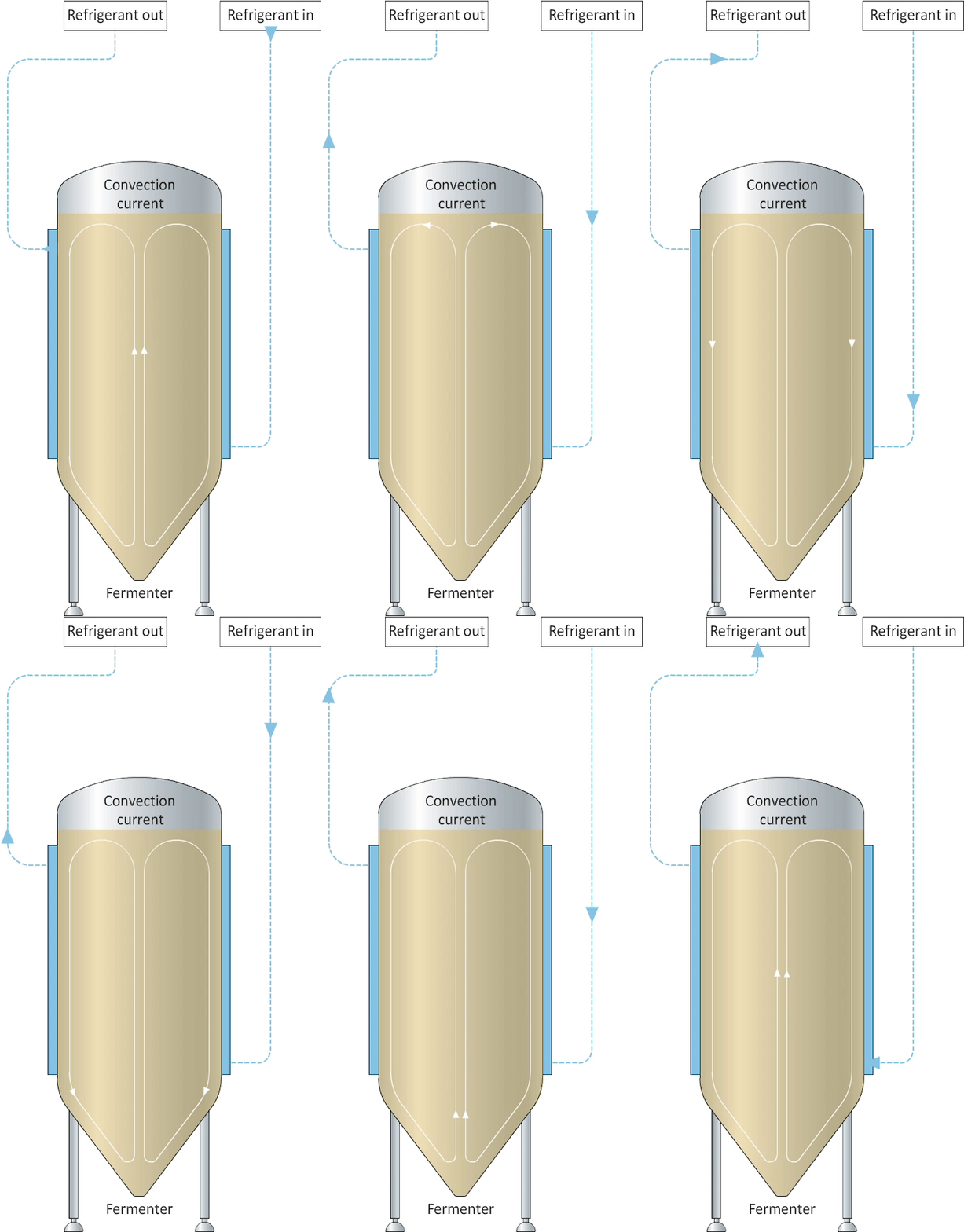
Figure: Natural convection during post-fermentation cooling
Recall that the rate of heat transfer is dependent on the temperature difference between the bulk fluid and the solid heating source. The greater the difference in temperature, the greater the rate of convection. Therefore, the convective flow when the beer is at 20°C will be greater than when it is at 5°C.
Some typical values for natural convection and film heat transfer coefficients are shown below.
-
Natural convection in air, gases, and dry vapours: 0.5 – 1,000 Wm-2 K-1
-
Natural convection in water and liquid: 50 – 3,000 Wm-2 K-1
-
Typical natural film heat transfer coefficients in large vessels are in the range of 50 to 250 Wm-2 K-1.
Let’s do an example of heat transfer due to natural convection. Let’s say we want to calculate the convective heat loss from a window in your home during the winter. The window is presumably the same temperature as your home, about 20°C. The window has a height of 0.8 m and a width of 1.2 m. The temperature outside is 2°C. The film heat transfer coefficient is 6.0 Wm-2 K-1.
First let’s recall the modified Fourier equation applied to heat transfer across the boundary layer between the solid and fluid interface and the bulk fluid:

We are being asked for the rate, not the rate per area, so let’s move the area to the other side of the equation.

The area of heat transfer is the entire window. To calculate the area of the window we multiply the height by the width.

Next, we need to assign values for Tw and T∞. Recall that Tw is the temperature of the wall. In this case that would be 20°C. T∞ is the temperature in the bulk fluid far away from the wall. In this example that would be 2°C.

Lastly, the film heat transfer (h) is given in the problem statement. We are now ready to enter the values and calculate.


So under steady state conditions, your house is losing about 104 W heat through the window in this example.