
Lesson 4 - Convection
This lesson deals with the principles and application of a form of heat transfer called convection. More specifically, it describes the heat transfer mechanisms that involve convection and calculation methods for heat transfer rates determined by convection and phase changes.
The Boundary Layer
Before we get into the specifics of convection, it is important to understand the relationship between conduction and convection at the point of heat transfer. For this, we need an understanding of the boundary layer.
A boundary layer is defined as the part of a moving fluid in which the fluid motion is influenced by the presence of a solid boundary.
In all flow systems where a liquid is flowing over a solid, a boundary layer is formed at the interface between the solid surface and the fluid.
The boundary layer is formed due to differences in velocities of the molecules within the fluid near and far away from the surface.
On the surface of the solid, the molecules tend to stick to the wall, resulting in a velocity of zero at the interface. The molecules close to the surface that are not stuck are moving parallel to the plate, and do not move in any direction other than the direction of flow. It is not surprising, then, that the flow near the surface is laminar (smooth-flowing). We call this the laminar layer.
Further away from the surface, the fluid velocities become larger. The flow in this part of the boundary layer may become turbulent. Between the layer of fully developed turbulence and the layer of laminar flow is a transition zone.
The presence of these different layers in a flow system is shown in the figure below.
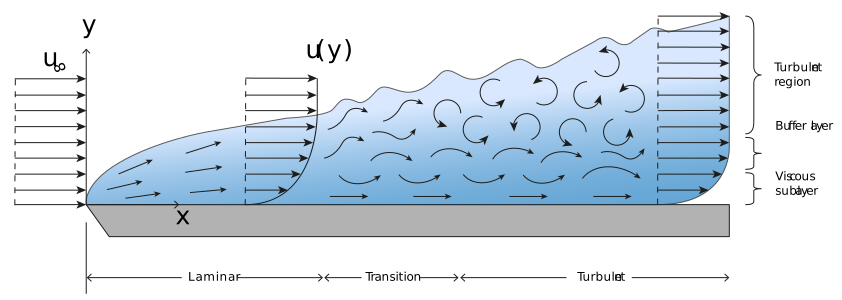
Figure: Layers in steady state flow over a flat plate
The figure above shows the development of the flow over a flat surface. Starting on the far left, when the fluid first begins flowing over the surface, the flow regime is not fully developed, also known as non-steady (unsteady) state. As it continues over the surface, the flow regime is fully developed and the distinction between the layers can be seen on the far right of the figure. When the flow is fully developed, we refer to it as being at steady state.
Within the laminar layer, heat transfer occurs via conduction.
Recall that conduction is the transfer of heat via molecules that are in direct contact with one another. Therefore, in the laminar layer, the adjacent molecules transfer heat between the wall and the liquid molecules when they touch each other.
Recall that the thermal conductivity, k, is a property of the substance that tells us how easily heat is transferred within the material. We can also call this the conductivity heat transfer coefficient. In liquids and gases, molecules are free to move around compared to when they are in a solid state. Therefore, heat is transferred relatively easily in solids compared to liquids and gases. Moreover, conductivity heat transfer coefficients of liquids and gases are generally much lower than most solids.
Additionally, when molecules are flowing in a predictable laminar manner, they do not contact each other as much as they do in turbulent flows. In turbulent flow, molecules are bouncing around in many directions, resulting in more contact and easier heat transfer.
Taking all of this into consideration, it is not surprising that the laminar flow region of fluid flow is a large source of resistance to heat transfer. Moreover, the thickness of the laminar flow region has a direct impact on the ease of heat to be transferred between a solid and a fluid.
So, you may be asking yourself, how do you know what the thickness of the laminar layer will be? The answer to this is pretty in-depth and is more than a brewer needs to know. However, the important thing to know is that the more turbulence in the flow, the thinner the laminar layer will be.
By looking at the Reynolds number value, we can determine whether the flow will be laminar or turbulent. For flow through circular pipes, laminar flow is considered to be present for Reynolds numbers up to 2,100. Turbulent flow in circular pipes is considered to be present for Reynolds numbers exceeding 4,000. For other geometries there is a unique Reynolds number which marks the onset of turbulent flow. For example, in plate heat exchangers it will be quite different in magnitude to that for circular pipes.
Refer back to the Fluid Mechanics Unit if you need a refresher on these topics.
In other words, it is the hydrodynamic conditions of the flow that will determine the degree of turbulence and therefore the thickness of the laminar layer and resistance to heat transfer.
The concept of a film heat transfer coefficient, h, was developed to understand and estimate the resistance to heat transfer that occurs across the interface of a solid surface and fluid. We will look at this next.