
Lesson 1 - Introduction to Heat Transfer
This lesson introduces the Heat Transfer Unit. It also contains a brief overview of the topics that you will study in the unit, as well as examples in brewing and malting.
Topics Covered in This Unit
This unit does not require any formal pre-requisite knowledge, and therefore we will introduce the topics as if you have not had any formal study of heat transfer. The concepts of heat transfer can get very technical, but this unit is meant to provide you with the necessary tools a brewer needs to communicate about and evaluate heat transfer principles found in the brewery.
You may not realise how familiar you already are with heat transfer – it is everywhere in our world!
Anywhere a temperature difference exists between solids, liquids, or gases, heat transfer is occurring. The heat transfer always occurs from hot to cold.
Every time you cook, drive a car, or walk into a heated or cooled building, you are reaping the benefits of heat transfer. Can we brew without heat transfer? The answer is no! The ability to heat and cool in the brewery is critical. Some important brewery heat transfer examples include:
-
Malting processes such as kilning
-
The heating of mash water as well as the mash vessel with steam. And let’s not forget about the production of steam itself!
-
Using steam to boil your wort in the kettle
-
Passing wort through a heat exchanger with cooling water to lower the temperature of wort to fermentation temperature
-
Using cooling water or glycol systems to maintain fermentation temperature and later cooling to conditioning temperature
Brewing and beer quality are fully reliant on principles and control of heat transfer.
We will now provide a brief overview of some of the topics covered in this unit.
For example, you will explore:
-
Forms of heat energy, including latent and specific heat. This includes the energy required to change the temperature and phase of a substance. You will even learn how to calculate this required amount of heat energy.
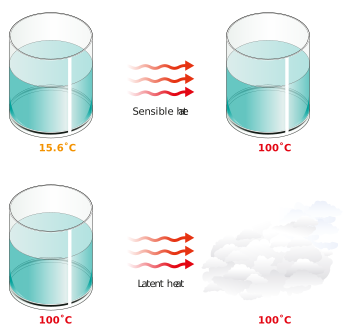
Figure: Sensible and latent heat
-
How heat is transferred differently based on the driving force and materials involved. This unit will explain the heat transfer mechanisms, including conduction, convection, and radiation.
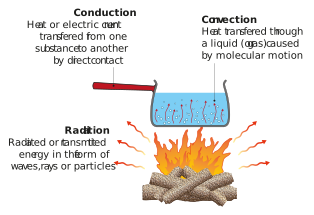
Figure: Cooking over a campfire – demonstration of mechanisms of heat transfer
-
Why certain materials are chosen to either aid in (conduct) or inhibit (insulate) heat transfer based on the thermal conductivity of the material.
-
The mechanism and difference between forced and natural convection in liquids. Furthermore, the different types of stages and modes of boiling and condensing.
-
The importance of heat loss due to radiation in a brewery and how to mitigate or control it.
-
How to calculate an overall heat transfer coefficient for a multi-layer and multi-substance heat-transfer problem.
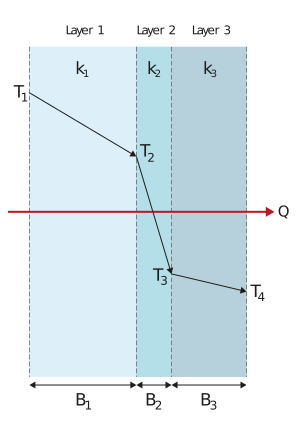
Figure: Conduction through a three-layer system
-
How to calculate the total heat lost or gained from a pipe or piece of equipment.
-
The technologies used for heat transfer in a brewery, including insulation, plate and shell and tube heat exchangers, and jacketed vessels.
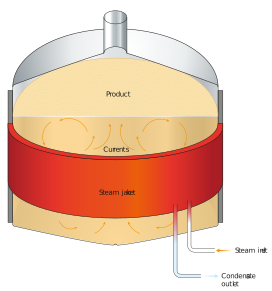
Figure: Heat transfer surface area of a jacketed vessel
-
How to determine the heat or cooling load required for a given task in the brewery, and how to design and size a heat exchanger for this purpose.
-
The factors that influence the actual performance of a heat exchanger in a brewery, and how these can be managed.