
Lesson 5 - Gas Transfer SAQ
This lesson provides the opportunity for you to test yourself on the material covered in Lesson 4 on Gas Transfer and determine to what level you have attained the outcomes.
Suggested Response - Q2
**/*** As part of a pasteurisation process, carbonated lager is heated to 70°C. If the dissolved CO2 concentration is 2.2 v/v at STP, what is the minimum pressure required to ensure that CO2 doesn’t come out of solution? You may make use of the Henry’s law graph below.
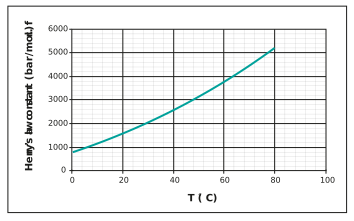
Figure: Henry’s law constant variation with temperature (CO2 in beer)
Response:
Conceptually, this is quite a straightforward problem, as in order to ensure that gas doesn’t come out of solution at 70°C, we need to ensure that the minimum pressure is equivalent to the partial pressure of CO2 at that temperature. We will use Henry’s law:

But we need a value for H. This is simple enough, as we are given a chart of H against T, so from that graph, at 70°C, H = 4,450 bar/mol.fr.
The CO2 concentration is 2.2 v/v at STP. To convert this to a molar fraction, let’s consider a dissolved CO2 concentration of 1 v/v at STP in 1 L of water as a basis for the determination of our conversion factor.
2.2 v/v at STP in one litre of beer is a concentration of 2.2 L of dissolved CO2 in 1 L of beer at STP. Using the ideal gas law, we can determine the mass of 2.2 L of CO2:


The molar mass of CO2 is 44 kg/kmol, and we can assume that the molar mass of beer is that of water, namely 18 kg/kmol. Hence the molar quantity of CO2 in 1 litre of beer is given by:

There is an alternative way of obtaining this answer by simply using the relationship that 1 kmol of any gas occupies 22.4 m3 at STP.
That is, 1 kmol, being 44 kg of CO2 gas, would occupy 22.4 m3 = 22,400 L. Therefore, 2.2 L of CO2 gas (in our 1 L of beer), when expressed in molar units, will be 2.2/22,400 = 9.8 x 10⁻⁵ kmol.
The number of kmol equivalent of 1 L of beer (assume a density of 1,000 kg/m3) is calculated as:

Hence the molar fraction of dissolved CO2 in beer x is given by:

Hence, using Henry’s law:

In this type of situation, the effect of the CO2 moles in the denominator is small, and has negligible effect on the result, so it is sometimes ignored.