
Lesson 5 - Gas Transfer SAQ
This lesson provides the opportunity for you to test yourself on the material covered in Lesson 4 on Gas Transfer and determine to what level you have attained the outcomes.
Self-Assessment Questions
-
**/*** Determine the equilibrium solubilities of oxygen (mg/L) in water at 298 K and 1 atm a, using atmospheric air (21% v/v oxygen) and pure oxygen. The Henry’s law constant for the solubility of oxygen in water at 298 K is 770 atm/mole per L.
-
**/*** As part of a pasteurisation process, carbonated lager is heated to 70°C. If the dissolved CO2 concentration is 2.2 v/v at STP, what is the minimum pressure required to ensure that CO2 doesn’t come out of solution? You may make use of the Henry’s law graph below.
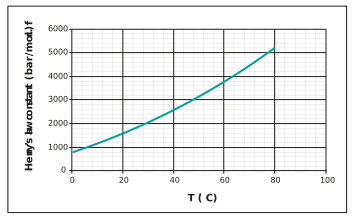
Figure: Henry’s law constant variation with temperature (CO2 in beer)
-
** A small 5 hL vertical cylinder bright beer tank is fitted with a sintered stone CO2 gas diffuser in its base, and also has the capability to pressurise the headspace with CO2. The tank is initially filled with bright beer which is below the brand specification for dissolved CO2. Two means of resolving this are being considered:
a) Supply of CO2 through the sintered stone gas diffuser for an extended period and increase in headspace pressure.
b) Increase in headspace pressure alone.
With reference to the following expression, discuss the relative rates of gas transfer which may be possible using either means.

-
**/*** A yeast propagation vessel – rated as a pressure vessel – is to be provided with either compressed air or pure oxygen for yeast growth. With reference to Henry’s law, amongst others, describe which gas, if any, would allow greater quantities of oxygen and/or at a faster dissolution rate to be dissolved in the propagation broth.