
Lesson 11 - Control of Fluid Flow 2 SAQ
This lesson provides the opportunity for you to test yourself on the material covered in the lesson on Control of Fluid Flow 2, and to determine the level to which you have met the learning outcomes.
Suggested Response - Q4
**A whirlpool is connected to a cast-out pump, with an NPSHR of 2 m water, using a suction line of length 10 m with a linear pressure drop of 0.75 kPa/m. If the wort has a vapour pressure of 90 kPa a, what would the required value be of the vertical head between the whirlpool outlet and the pump inlet to ensure the pump does not cavitate?
Wort density is 1,060 kg/m3, and atmospheric pressure is 100 kPa.
Response:
We can represent the problem in a diagram:
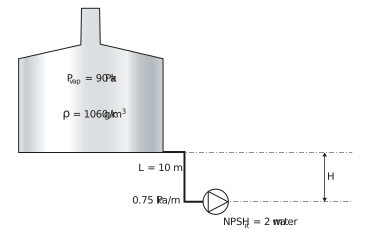
In order for the pump to operate safely, i.e. without cavitating, we require NPSHA ≥ NPSHR:

NPSHA is given by:

Where the pump suction head, HSuction, is given by:


Hence:

We must be careful here as some of the head values are in metres of wort and water, and as the densities of these liquids are different, the heads are not directly comparable. So let us convert everything into pressures:

It should be noted that H, the hydrostatic head between the base of the whirlpool and the pump suction, is the unknown.


