
Lesson 11 - Control of Fluid Flow 2 SAQ
This lesson provides the opportunity for you to test yourself on the material covered in the lesson on Control of Fluid Flow 2, and to determine the level to which you have met the learning outcomes.
Suggested Response - Q2
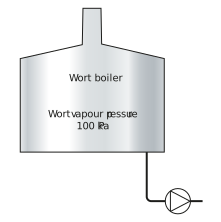
**/*** Consider the plant layout below, in which a wort cast-out pump is connected to a wort boiler with a vertical suction line. Describe what you would expect to happen as the boiler is emptied. You may consider the atmospheric pressure to be 101 kPa.
Response:
When pumping hot liquids, particularly in this case with a liquid (wort) just below its boiling point (the vapour pressure is slightly less than atmospheric pressure), we would be concerned about the wort flashing and cavitating. This is especially so if the suction line pressure dropped too low at the pump inlet. Specifically, we know that to avoid cavitation, we need to ensure that the NPSHA at the pump inlet ≥ NPSHR at all times.
For the plant, as shown, the NPSHA is given by:

And:

Yielding:

Typically, this would be the point in the problem where we would go back to the problem statement, extract some numbers and pop them into the equation. But, we have very little of that information available to us, so now what?
Well, now we have to give our calculators a rest and apply some thinking to the problem so we can get more of a feel for it. This will lead us to make some educated guesses.
So, what do we know, and what can we make educated guesses about? Well, we are told that the atmospheric pressure and the vapour pressure are very similar, i.e. 101 and 100 kPa, respectively. Expressed as heads of water, these have a density of 1,000 kg/m3, which gives 10.3 and 10.2 m, respectively. Let us now insert this into the equation:

As the atmospheric head and vapour pressure (head) are so similar, let us cancel them out, which thus leaves:

At all times, we want this to be greater than NPSHR so:

What can we predict about NPSHR? We know that it might range from 3 to 6 m or greater depending on the total capacity of the pump, and if it is a low NPSH pump, then the NPSHR might be as low as 0.5 m. Let us now look at two cases: 6 and 0.5 m respectively.
If NPSHR = 6 m, to avoid cavitation:

If we rearrange for HWort:

We know that the value of DHlost will always be positive, even if it is small due to a short suction line run, or minimal fittings. If we consider it to be exceptionally small, or ≈ 0 m, then the equation becomes:

If the head of the wort is ≤ 6 m at any time, the pump will cavitate. We should think about this for a bit!
Is it possible to have a 6 m head of wort on a pump, intended to empty a tank, at all times? Well, no, it is not!
Even if the base of the boiler is 6 m above the pump suction and the suction line emptied below the 6 m level, the pump will begin to cavitate. It would only be the last bit of wort in the line which would experience cavitation (e.g. a 75 mm internal diameter pipe has a linear volume of 4.4 L/m). But, this could be sufficient to cause some damage to the pump and also impair the final transfer to the whirlpool.
What if we used a low NPSH pump, with NPSHR = 0.5 m? With the same logic as above:

We can see that the pump would only cavitate when the wort head on the pump was < 0.5 m, which is a much-improved situation.
We should note here that any cast-out pump with the function of emptying an atmospheric tank, is likely to cavitate near the end of cast-out. This is due to the head on the pump (NPSHA) reducing to below the NPSHR.