
Lesson 11 - Control of Fluid Flow 2 SAQ
This lesson provides the opportunity for you to test yourself on the material covered in the lesson on Control of Fluid Flow 2, and to determine the level to which you have met the learning outcomes.
Suggested Response - Q3
**A carbonated dilution water tank is connected to a main, which feeds a pump with an NPSHR of 3 m water. The pump inlet is 1 m below the tank outlet, and the suction line is 20 m long and has a linear pressure drop of 0.5 kPa/m. The equilibrium pressure associated with the dissolved CO2 content is 0.8 bar g, and atmospheric pressure is 100 kPa.
What is the minimum headspace pressure you would require to ensure the tank empties without the pump cavitating?
Response:
Let us look at the problem with a sketch (below).
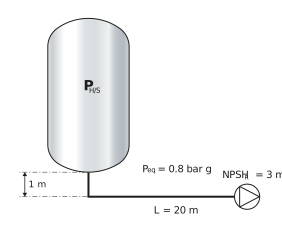
To avoid pump cavitation, we need to ensure that:

For cavitation to
occur:
NPSHA = NPSHR
As the answer is required in pressure units, we convert NPSHA into NPSPA:

So, for cavitation to occur:

During cavitation there is no phase change, but gas evolution can occur. Therefore we use equilibrium pressure (PEQ) instead of vapour pressure.
By definition:

Where Ps is manometric pressure in the suction side of the pump, and PEQ is the equilibrium pressure.
Rearranging, we get:

As we know the NPSPA for cavitation, and PEQ was given:
Ps = 29.43 + 80
Ps = 109.43
This means that the system is at risk of cavitation if the pressure in the suction side of the pump drops below 109.43 kPa.
We can now use Bernoulli’s equation between the bottom of the tank and suction side of the pump to find the required pressure in the tank headspace:

We can rearrange the equation to calculate the PH/S when cavitation occurs:

Frictional losses can be expressed as:

We replace to get:


So, the pump will not cavitate if tank headspace pressure is above 109.62 kPa.