
Lesson 11 - Control of Fluid Flow 2 SAQ
This lesson provides the opportunity for you to test yourself on the material covered in the lesson on Control of Fluid Flow 2, and to determine the level to which you have met the learning outcomes.
Self-Assessment Questions
1. *Describe the mechanism of cavitation, its cause and the impact on pump operation and integrity.
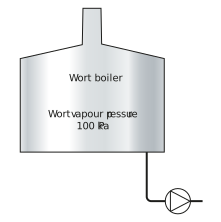
2. **/***Consider the plant layout below, in which a wort cast-out pump is connected to a wort boiler with a vertical suction line. Describe what you would expect to happen as the boiler is emptied. You may consider the atmospheric pressure to be 101 kPa.
3. **A carbonated dilution water tank is connected to a main, which feeds a pump with an NPSHR of 3 m water. The pump inlet is 1 m below the tank outlet, and the suction line is 20 m long and has a linear pressure drop of 0.5 kPa/m. The equilibrium pressure associated with the dissolved CO2 content is 0.8 bar g, and atmospheric pressure is 100 kPa.
What is the minimum headspace pressure you would require to ensure the tank empties without the pump cavitating?
4. **A whirlpool is connected to a cast-out pump, with an NPSHR of 2 m water, using a suction line of length 10 m with a linear pressure drop of 0.75 kPa/m. If the wort has a vapour pressure of 90 kPa a, what would the required value be of the vertical head between the whirlpool outlet and the pump inlet to ensure the pump does not cavitate?
Wort density is 1,060 kg/m3, and atmospheric pressure is 100 kPa.