
Lesson 7 - Principles of Fluid Mechanics 3 SAQ
This lesson allows you to test yourself on the material covered in the lesson on Principles of Fluid Mechanics 3, and to determine the level to which you have met the learning outcomes.
Suggested Response - Q4
**During a design meeting for refitted CO2 bung lines (the CO2 vent lines from a fermenter), you are offered two sizes (a 50 mm or a 65 mm internal diameter). The maximum gas flowrate is expected to be 180 kg/h, and the maximum line length will be 65 m. The frictional pressure drop over the line must be kept below 5 kPa to limit excessive fermenter headspace pressure. Which line diameter would you choose and why?
Assume a surface roughness of 0.05 mm; ρ = 1.9 kg/m3; and µ = 15 x 10-6 kg/ms.
Response:
The volumetric flowrate of CO2 would be determined from the mass flowrate and the density:

The volumetric flowrate would be given by:

Let us consider the 50 mm line in detail. In order to calculate the Reynolds number we need to know the line velocity:


Consequently, the Re is given by:

Therefore, Re > 4,000, which confirms the flow is turbulent and we need to use the Moody chart to determine the friction factor:

From the Moody diagram, we can determine that the friction factor is 0.006. So, using the Darcy-Weisbach equation:


This frictional pressure drop exceeds our required maximum of 5 kPa, so we would reject the 50 mm bung line.
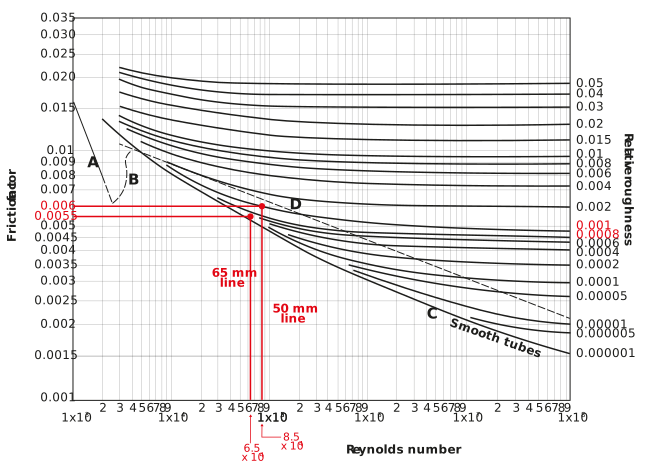 Repeating the same consideration for the 65 mm options gives the following parameters (check these for yourself on the Moody chart above):

Therefore, with the 65 mm line, the frictional pressure drop is 2.8 kPa, which is below the maximum permitted, so we would choose this line size.