
Lesson 5 - Principles of Fluid Mechanics 2 SAQ
This lesson allows you to test yourself on the material covered in the lesson on Principles of Fluid Mechanics 2, and to determine the level to which you have met the learning outcomes.
Suggested Response - Q3
**A double-pipe heat exchanger consists of a section of a smaller diameter pipe within a larger diameter pipe, creating two flow paths as shown in the figure below. The outer pipe has an internal diameter of 50 mm. The inner pipe has an external and internal diameter of 33 and 25 mm, respectively.
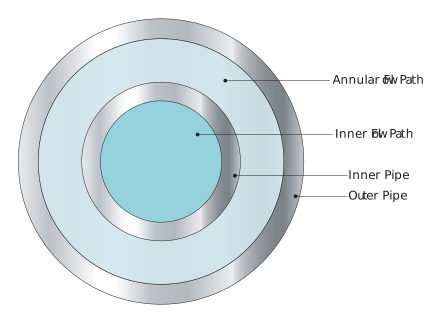
Water is pumped through the annular flow path and the inner flow path at the same rate of 50 hL/h. Determine the Reynolds number for both flows and state whether the flows are laminar, transitional or turbulent. (Density and dynamic viscosity are 1,000 kg/m3 and 1 cP respectively).
Response:
The geometry of a pipe-within-a-pipe may seem a bit strange, but it can be quite common in so-called double-pipe heat exchangers. It is important to differentiate between the two flow paths (the inner flow and annular path). To determine the Reynolds number, we use the following equation:

As the two flow paths have differing geometries, with the annular flow path being non-circular, we need to use the equivalent diameter de. Let us deal with the two flow paths separately.
The inner flow path
The flow area is simply that of a circle of diameter 25 mm, therefore the flow area is given by:

The flow velocity is given by rearranging the following equation:


Hence the Re is:

As this Re is greater than 4,000, we can state that the flow would be turbulent.
Annular flow path
The flow area is the area of the annulus (a ring-shaped object, structure, or region). This can be determined as the area of a 50 mm diameter circle, from which we deduct the area of a circle of diameter 33 mm (the latter is the area of the inner pipe cross-section using its outer diameter):

The flow velocity is given by rearranging the following equation:

The diameter that we need to use is the equivalent diameter of the annulus. This is given by:

We have already calculated the cross-sectional flow area at 0.0011 m2. The wetted perimeter would be the length equivalent to the circumference of the inside of the external pipe summed with the circumference of the outside of the internal pipe (you might need to read the previous sentence again! Note there are two separate perimeters which the flow passes between). Consequently, the wetted perimeter is given by:


Therefore, de is:

And the Re is:

As this Re is greater than 4,000, we can state that the flow would also be turbulent.