
Lesson 5 - Principles of Fluid Mechanics 2 SAQ
This lesson allows you to test yourself on the material covered in the lesson on Principles of Fluid Mechanics 2, and to determine the level to which you have met the learning outcomes.
Suggested Response - Q1
*/**High gravity (HG) beer is diluted inline, within a 100 mm internal diameter pipe, to sales gravity (SG) through the addition of dilution water. If the HG beer and dilution water volumetric flowrates are the same at 500 hL/h each, what would be the volumetric flowrate of the SG beer? The densities of the HG, SG beers and dilution water are respectively 1,007, 1,004 and 1,000 kg/m3.
Response:
A simple sketch will help us visualise the situation.
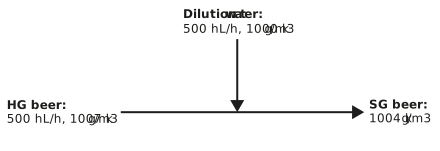
Before we solve this problem, which is a ‘continuity of mass’ problem, let us state what the answer is not.
We cannot simply add the volumetric flowrates of HG beer and dilution water (500 + 500 = 1,000 hL/h) to get the flowrate of SG beer. Why? Well, we know that mass is conserved, but volume is not strictly conserved. As the densities of the three streams are different, we need to account for their impact on the mass and volume flowrates of each stream, however small this effect might be.
Conservation of mass at the dilution point can be expressed as:

G is the mass flowrate of the three streams respectively: HG (high gravity), DW (dilution water) and SG (sales gravity).
We can determine the mass flowrates of the HG and DW streams using the respective values of density:


Hence, the mass flowrate of SG beer is:

The volumetric flowrate of SG beer can be determined from:


So, the volumetric flowrate of the SG beer stream is 999.5 hL/h, which is slightly less than the speculated value of 1,000 hL/h. One might argue that a 0.05% difference would be acceptable in such a practical situation. What do you think?