
Lesson 5 - Principles of Fluid Mechanics 2 SAQ
This lesson allows you to test yourself on the material covered in the lesson on Principles of Fluid Mechanics 2, and to determine the level to which you have met the learning outcomes.
Suggested Response - Q2
Wort with a density of 1,080 kg/m3 enters an empty fermenter, which is vented to atmosphere. The wort enters through a 150 mm internal diameter vertical pipe at a flowrate of 1,000 hL/h. Determine the following:
a) * The average flow velocity in the 150 mm pipe.
b) ** An estimate of the height of the initial jet that the wort would form if the wort pressure at the fermenter inlet is 0.05 bar g.
c) ** Quantify any change in the height of the fountain if the inlet velocity was halved from that in part a.
Response:
a) The average flow velocity can be determined from consideration of the following equation:

And rearranging for the average flow velocity  :


b) To estimate the height of the initial jet in the empty fermenter, we must consider how the energy within the incoming wort stream would be conserved when the wort enters the fermenter. Consideration of Bernoulli’s equation allows us to do this:

Let us apply this to a sketch of the fermenter inlet.
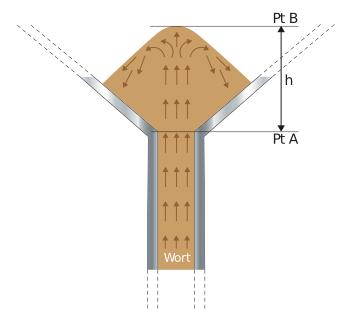
Point A is at the entry to the fermenter, where the pressure is 0.05 bar g, and the average wort velocity is 1.57 m/s (from part a) above).
Point B is at the top of the initial fountain (or plume) that the wort would form when it enters an empty fermenter. The pressure here would be 0 bar g, i.e. the same as the atmospheric pressure in the fermenter, and its average vertical velocity would be 0 m/s. The vertical distance h would be the distance between the fermenter inlet and the top of the fountain, relative to a datum, such that h = (hB-hA).
Applying these conditions to Bernoulli’s equation:

And collecting like terms:

Substituting for known terms:


c) Recalculating with = 1.57/2 = 0.79 m/s.


