
Lesson 5 - Principles of Fluid Mechanics 2 SAQ
This lesson allows you to test yourself on the material covered in the lesson on Principles of Fluid Mechanics 2, and to determine the level to which you have met the learning outcomes.
Self-Assessment Questions
1. */** High gravity (HG) beer is diluted inline, within a 100 mm internal diameter pipe, to sales gravity (SG) through the addition of dilution water. If the HG beer and dilution water volumetric flowrates are the same at 500 hL/h each, what would be the volumetric flowrate of the SG beer?
The densities of the HG, SG beers and dilution water are respectively 1,007, 1,004 and 1,000 kg/m3.
2. Wort with a density of 1,080 kg/m3 enters an empty fermenter, which is vented to atmosphere. The wort enters through a 150 mm internal diameter vertical pipe at a flowrate of 1,000 hL/h. Determine the following:
a) * The average flow velocity in the 150 mm pipe.
b) ** An estimate of the height of the initial jet that the wort would form if the wort pressure at the fermenter inlet is 0.05 bar g.
c) ** Quantify any change in the height of the fountain if the inlet velocity was halved from that in part a.
3. ** A double-pipe heat exchanger consists of a section of a smaller diameter pipe within a larger diameter pipe, creating two flow paths as shown in the figure below. The outer pipe has an internal diameter of 50 mm. The inner pipe has an external and internal diameter of 33 and 25 mm, respectively.
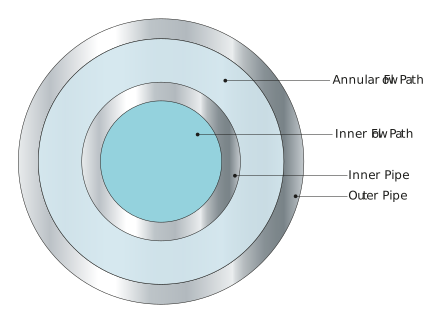
Water is pumped through the annular flow path and the inner flow path at the same rate of 50 hL/h. Determine the Reynolds number for both flows, and state whether the flows are laminar, transitional or turbulent. (Density and dynamic viscosity are 1,000 kg/m3 and 1 cP, respectively).
4. ** Bright beer is flowing down a pipe with an internal diameter of 125 mm. If the density and viscosity are 1,005 kg/m3 and 2 cP respectively, and the flow velocity is 2 m/s, confirm that the flow is turbulent. What internal pipe diameter would be required to ensure the flow was laminar, whilst achieving the same volumetric flowrate?