
Lesson 3 - Principles of Fluid Mechanics 1 SAQ
This lesson allows you to test yourself on the material covered in the lesson on Principles of Fluid Mechanics 1, and to determine the level to which you have met the learning outcomes.
Suggested Response - Q6
** Two identical bright beer tanks, A and B, are connected by a pipe and shut-off valves A and B, as shown in the figure below. When valves A and B are closed, the initial beer levels in both tanks, relative to the interconnecting pipe, are 7 m and 3 m, respectively. You may assume the tanks are open to atmosphere and that the beer density is 1,005 kg/m3.
If both valves are opened, what will the gauge pressures be for each tank, at the level of the interconnecting pipe? Explain your reasoning.
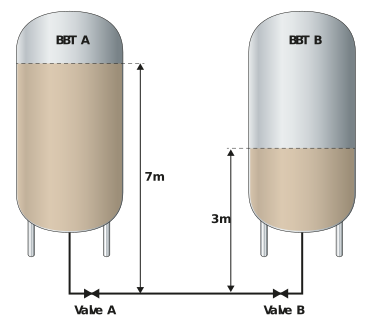
Firstly, we can recognise that in the initial situation, the differing levels (head) of beer in each tank will exert differing pressures on the closed valves in the interconnecting pipe, with BBT A exerting a larger head than BBT B, due to the larger head of beer.
Next, we have to ask ourselves what we would expect to happen when valves A and B are opened initially? Due to the larger head of beer in BBT A, it would force beer into BBT B, until such time that the head in BBT A equalled the head in BBT B, i.e. the beer would be at the same level in each tank, and hence the gauge pressure due to each tank would be the same.
The next question is what level this would be relative to. This would be the level of the interconnecting pipe – halfway between the current levels (7+3) / 2 = 5 m. (This is only correct as both tanks are open to atmosphere, so there can be no build-up of pressure in the head space of either tank).
Now we can determine the gauge pressure due to a 5 m head of beer at a density of 1,005 kg/m3:
