Lesson 3 - Principles of Fluid Mechanics 1 SAQ
This lesson allows you to test yourself on the material covered in the lesson on Principles of Fluid Mechanics 1, and to determine the level to which you have met the learning outcomes.
Self-Assessment Questions
-
* Which of the following combinations are fluids?
a) Solids and gases
b) Gases and liquids
c) Liquids and solids
-
* Which of the following describes the viscosity of a fluid?
a) How dense a fluid is
b) The cosine of the angle of runniness
c) How easily a fluid flows
d) How easily visible light can pass through the fluid
-
* Newton’s law of viscosity defines the viscosity of a Newtonian fluid as what?
(More than one answer may be appropriate):a) A constant
b) A constant of proportionality
c) Independent of shear rate
d) Independent of shear stress
e) A function of shear rate
f) A function of shear stress
g) The ratio of shear stress to shear rate
h) The ratio of shear rate to shear stress
-
*/** A Bourdon pressure gauge indicates a gauge pressure of 150 kN/m2. What would be the absolute pressure, if the atmospheric pressure is 740 mm Hg? You may assume the density of mercury is 13,600 kg/m3.
-
*/** A carbon dioxide collection balloon may be considered a cylinder of 8 m in length and 3 m in diameter. If the internal pressure is 5 kPa (g), what will be the total force, and the net force, on the inside surfaces of the balloon? Atmospheric pressure is 95 kPa.
-
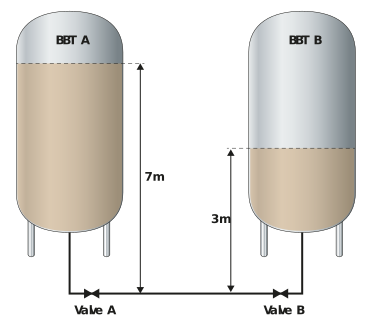
** Two identical bright beer tanks, A and B, are connected by a pipe and shut-off valves A and B, as shown in the figure below. When valves A and B are closed, the initial beer levels in both tanks, relative to the interconnecting pipe, are 7 m and 3 m, respectively. You may assume the tanks are open to atmosphere and that the beer density is 1,005 kg/m3.
If both valves are opened, what will the gauge pressures be for each tank, at the level of the interconnecting pipe? Explain your reasoning.