
Lesson 1 - Introduction to Fluid Mechanics
This lesson introduces the Fluid Mechanics unit. It also contains a brief overview of the topics that you will study in the forthcoming unit.
Topics Covered in this Unit
This unit does not require any formal pre-requisite knowledge, so we will approach it as if this is your first time formally studying fluid mechanics. Don’t worry, as we will take things at a steady pace to make sure that you understand and are able to apply the concepts in practical situations.
Even if you have done some basic practical brewing before, but have never studied fluid mechanics, you will be very familiar with the practical side of fluid mechanics. All practical brewing involves the use of fluids – both gases, such as air and oxygen, and liquids such as water, wort, and beer – as well as their transport and control. Whilst brewing, you may have:
-
Filled your brewing vessels with water from a tap – that water had to be pumped to you through a designed pipe system and controlled with a valve (a tap!).
-
Used gravity to transfer wort between vessels – gravity creates particular types of pressures to drive such flows.
-
Perhaps used a pump to empty your fermenter. How did you go about sizing the pump and determining its impact on the speed of emptying?
Brewing is fully reliant on fluids, their transport, and their control.
In this unit, you will explore:
-
How fluids consist of gases and liquids, but not solids: it’s the ability to flow (the Latin word, fluidus, which means ‘to flow’) that defines a fluid.
-
How the atmospheric pressure exerted on us and our breweries is caused by the column of air in the atmosphere directly above us, pushing down on us. You will learn how to account for differences in altitude, which dictate atmospheric pressure changes. These differences are of course determined by your brewery’s location.
-
How we owe a debt of thanks to a watchmaker who invented one of the workhorses of fluid pressure measurement: the Bourdon gauge.
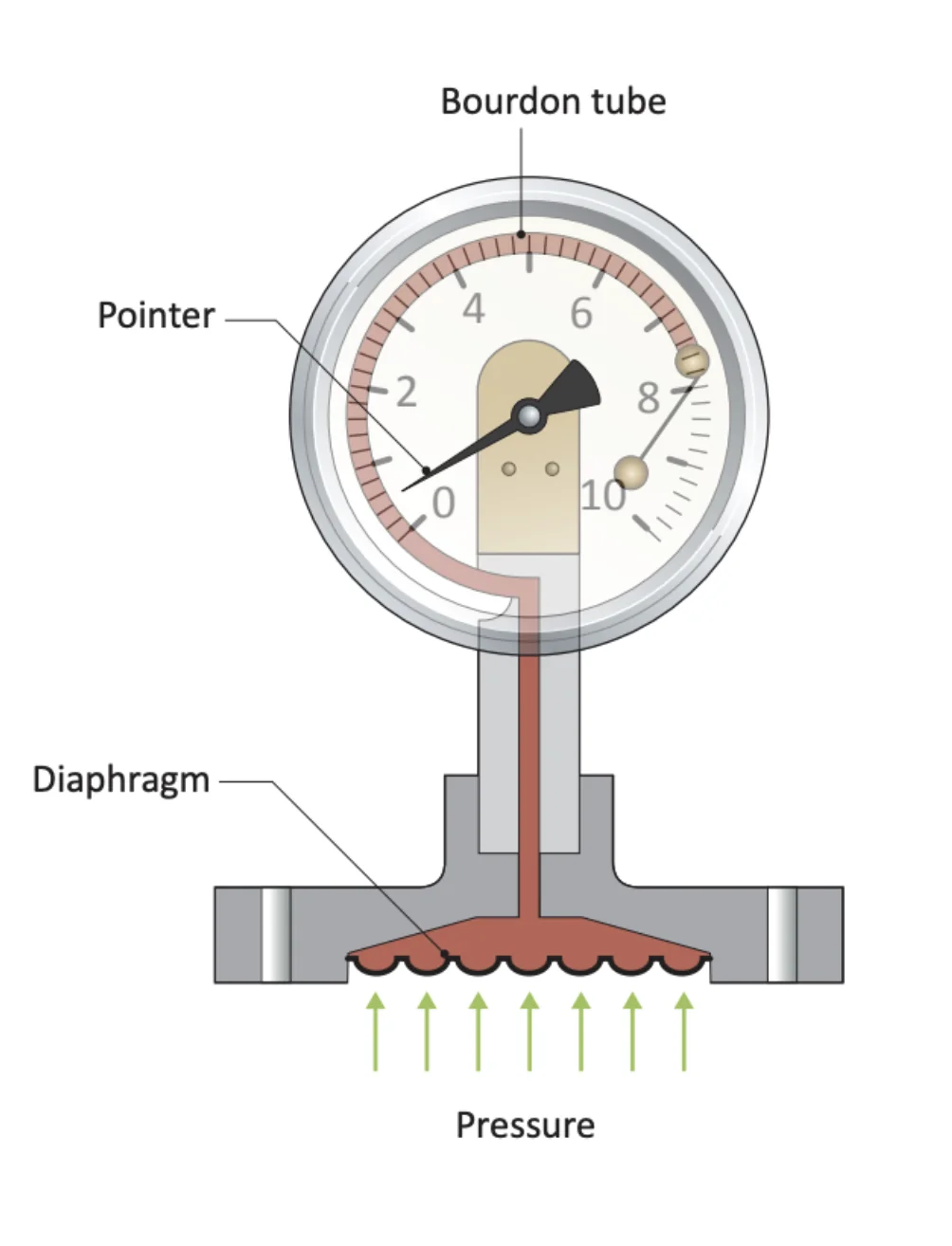
Figure: A Bourdon gauge
-
How the vast majority of brewery fluids are transported in pipes under a flow regime, termed turbulent flow. We will explore how we can define this using the Reynolds number.
-
The effect that the surface roughness of the inside of a pipe has on the pressure loss of the fluid.
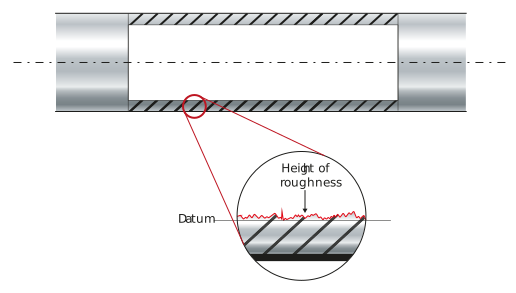
Figure: Surface roughness
-
How properly designed pipe systems tend to have common flow characteristics, such as pressure drop and flow velocity… these are not a coincidence… they are driven by design!
Table: Typical fluid mean velocities and frictional pressure drops
|
|
Mean velocity (m/s) |
∆Pf |
|
Liquids, pumped (not viscous) |
1-3 |
0.5 kPa/m run |
|
Liquids, gravity flow |
- |
0.05 kPa/m run
|
|
Gases and vapours |
15-30
|
0.02% of line pressure |
|
High pressure steam (> 8 bar) |
30-60 |
- |
-
Why we commonly use two differing types of pump in brewery applications, namely centrifugal and positive-displacement:
-
-
A centrifugal pump converts kinetic energy into pressure energy by using a pump of spiral-like geometry.
-
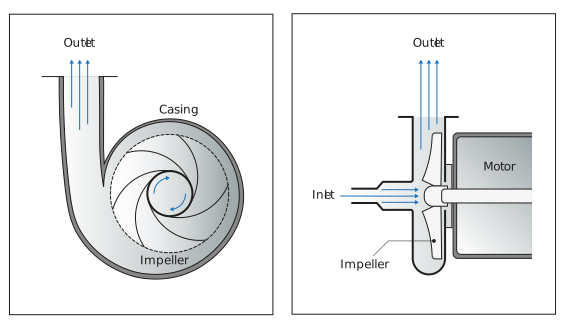
Figure: Two views of a centrifugal pump, showing the key parts.
-
-
A positive displacement pump uses the concept of volume entrapment and displacement to generate flow and pressure.
-
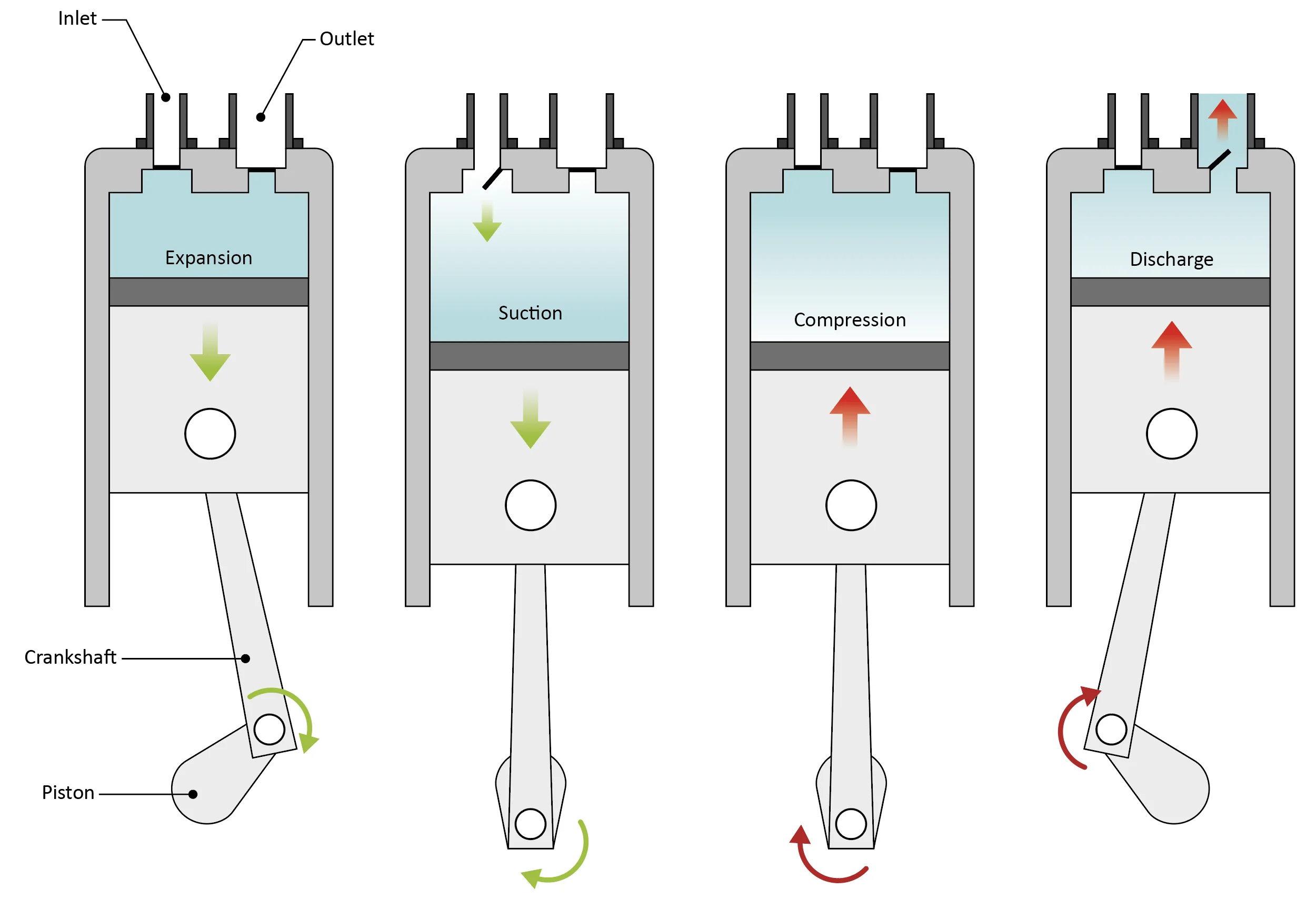
Figure: Suction and pressure cycles of a reciprocating positive displacement pump
-
How the proper specification of pumps and the correct design of pipework avoids a process called cavitation, which can damage pumps and control valves.
-
How valves are not created equally – some are better at controlling flow rather than switching it on or off. A ball valve (shown below) is good for both functions:
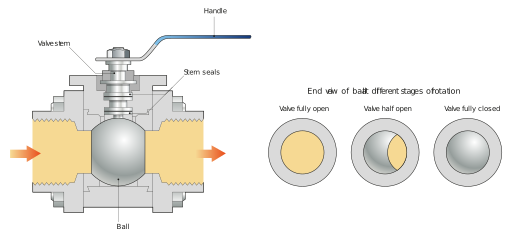
Figure: Ball valve
-
How to specify differing valve types for brewing processes, such as the whirlpool shown below:
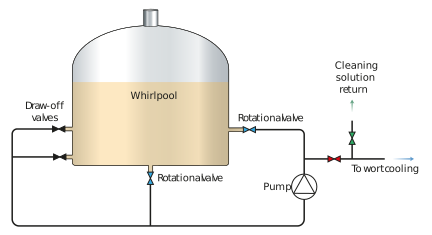
Figure: The whirlpool and its various valves