
Lesson 3 - Cleaning Systems and Control SAQ
This lesson allows you to test yourself on the material covered in the Cleaning Systems and Control lesson, and determine the level to which you have met the learning outcomes.
Suggested Response - Q5
***Describe an appropriate CIP design and operation for a cleaning 60 hL cellar vessels in a 3,000 hL per annum brewery. Explain what equipment you would use and the cleaning steps completed. What are the disadvantages and advantages of such a system?
Response:
The brewery is a microbrewery with small cellar vessels. It can be reasonably assumed that the operations are largely manual, with the filling of tanks performed with hoses connected from a central manifold.
The appropriate CIP system for this setup would be a manual portable CIP trolley with an attached manifold to the pump suction, which consists of three hose connections for CIP return: water, inlet and drain. On the pump’s discharge is a hose connection to the vessel bung line and spray head, with a mechanical flow meter.
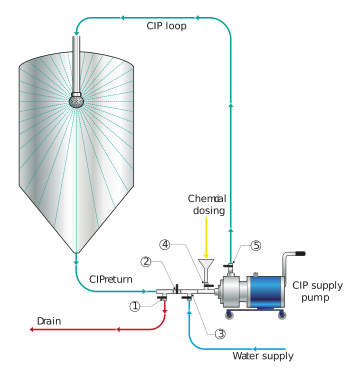
Operation of the system would be as follows:
|
Step |
Valves open |
Pump |
|
Pre-rinse |
3,5,1 |
On |
|
Make-up detergent water |
3,5 |
Off |
|
Add detergent |
4,5,2* |
On |
|
Circulate detergent for 30 minutes |
2,5 |
On |
|
Drain detergent |
1 |
Off |
|
Rinse detergent |
3,5,1 |
On |
|
Add sanitiser |
4,5,2* |
On |
|
Circulate sanitiser for five minutes |
2,5 |
On |
|
Drain sanitiser |
1 |
Off |
|
Rinse sanitiser |
3,5,1 |
On |
|
Drain vessel |
1 |
Off |
|
* throttle two and open four to dose chemical |
|
Although appropriate for a small operation, this system has both advantages and disadvantages.
Advantages include:
a) Low initial capital costs
b) Can be a portable unit
c) Simple controls (valves)
d) Lower maintenance
e) Fixed volume detergent dosed
f) Control of effluent discharges and smaller volumes
g) Small footprint area
Distavantages include:
a) It is manual therefore a safety risk to operators
b) It uses hoses which are more susceptible to microbial contamination
c) Water use is higher vs re-use
d) Chemical use is higher vs re-use