
Lesson 2 - Cleaning Systems and Control
This lesson explores the concepts of hygienic design and the Cleaning-in-Place (CIP) systems in the brewery. We examine the nature of soils, the chemicals used to remove them and how we can validate cleaning effectiveness. We also consider the optimisation of modern cleaning systems within the brewery.
CIP Plant Optimisation
In this section, we will discuss two linked aspects – tank cleaning optimisation and environmental optimisation. In cleaning optimisation, we discuss CIP delivery systems, and in environmental optimisation, we discuss use of water, energy and effluent.
Tank cleaning optimisation
Tank CIP uses a spray creating force onto the tank surface to assist with wetting and dispersion of soil. Three types of technologies are used for cleaning the tank:
1. Static spray ball
2. Rotary spray head
3. Rotary jet head
We shall discuss the operation of each type, individually.
Static spray ball
The static spray ball sprays detergent through a stainless steel ball containing multiple holes of defined diameters. The jets impact on defined points inside the tank, creating an area where they exert force and shear.
After hitting the tank surface, a layer of detergent forms, which runs down the sides of the tank as a thin layer. This generates shear stress on the walls of the tank in an irregular pattern. The three Sinner factors of time, chemical and temperature, determine when the tank is clean. The wall shear stress of the falling layer film is around 5 kPa and can be compared to that of a pipe filled with liquid flowing at a velocity of 1.5 m/s.
The selection of the spray ball design depends on the tank dimensions and its duty, as well as the location and distance from the liquid surface. In the case of fermenting vessels, there is heavy soil above the surface (trub ring), and the spray ball should be selected to impinge in this area. For this task, a 270º rather than a 360º coverage could be selected. To clean foam deposited on the dome of the vessel, it is important that the spray ball has a shoulder to direct flow upwards onto the dome.
The CIP pump pressure must match the design pressure and flow for the spray ball, which is typically between 1-2 bar. Too high a pressure will cause misting and too low insufficient spraying. Both will result in ineffective cleaning.
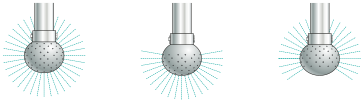
Figure: Static spray balls
Rotary spray head
Rotary spray head devices are dynamic in that they are designed to spin around an axis caused by the flow of the detergent leaving the spray head. The flow of the cleaning media released from the spray head causes the spray head to rotate. This allows the detergent impact at a higher force compared to the static spray ball.
The rotary spray head creates more efficient coverage and higher impact stress than the sprayball which allows a shorter cleaning time.
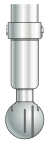
Figure: Rotary spray head
Rotary jet head
The rotary jet head creates the highest impact force and shear stress. It uses between two and four jets that rotate around two axes at a predefined speed. This provides complete coverage of the vessel’s surface over a defined period of time and at a defined pressure.
The impact and shear stress provided by rotary jet head cleaning are around 10 kPa. So, the rotary jet head provides significantly more cleaning force than the 5 kPa film shear stress of the water running down the walls when a static spray ball is used.
Due to these known factors, defined cleaning time is established. With higher forces on the tank surface, the amount of detergent, as well as the overall cleaning time, can be reduced.
The CIP supply pump needs to be designed to provide the correct pressure and flow rate for the cleaning head in use. Rotary jet cleaners operate at significantly higher pressures than spray balls, sometimes up to 12 bar, although typically 5-6 bar is recommended.
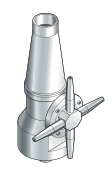
Figure: Rotary jet cleaner
This video shows the animated operation and key points of the three tank cleaning technologies discussed.
Note, this is for illustrative purposes only and is not a recommendation or endorsement of the supplier’s product:
Maintenance of spray cleaning devices
The blockage of holes in the spray balls and rotating spray jet cleaners must be avoided at all times as this seriously impairs their effectiveness. The devices must be on a maintenance inspection schedule to ensure that they are clear of the debris and function correctly.
Rotating jet cleaners are often fitted with a sensor on the vessel dome or side wall to confirm that the system is rotating. An enhancement of this is a dynamic pressure sensor which recognises that the impact, or interval of time, or both, fall within the acceptable limits. If abnormalities are detected, alarms will alert the operator to remedy the situation.