
Lesson 2 - Cleaning Systems and Control
This lesson explores the concepts of hygienic design and the Cleaning-in-Place (CIP) systems in the brewery. We examine the nature of soils, the chemicals used to remove them and how we can validate cleaning effectiveness. We also consider the optimisation of modern cleaning systems within the brewery.
CIP Operational Principles
We will now look at the operation of CIP systems, using a hot CIP of caustic, acid and disinfectant as an example to illustrate the principles involved.
Single use CIP
These systems vary in design, but can consist of two tanks: a water buffer tank and a detergent buffer tank, or as shown in the illustration, one detergent buffer tank. The supply pump is on the CIP plant; however, the return (scavenge) pump is in the field, underneath or near to the vessel being cleaned.
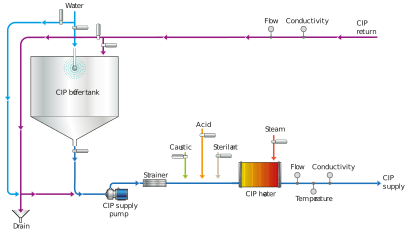
Figure: Single use hot CIP system
Pre-rinse
Fresh water is circulated through the plant then sent to drain. This is wasteful as fresh water rinsing is never recovered.
Detergent recirculation
The circulating fresh water and the circuit are dosed with the detergent (typically caustic) until the correct temperature and strength are achieved, using inputs from the temperature probe and conductivity meter. In some cases, there may not be a circulation loop to achieve the detergent strength and temperature specification, so instead the vessel being cleaned is filled with the water, and the detergent is then dosed in the tank and heated.
The detergent cycle then starts, and the detergent (caustic) is recirculated back to the CIP pump for a specified duration, which will depend on a range of factors described in the Sinner Circle. The temperature is controlled to set-point by a temperature measurement on the return main using the heat exchanger. Ambient temperatures are usually used on fermenters, maturation vessels and bright beer tanks, while hot CIP is performed on pipework and brewing vessels.
Do you remember why?
High temperatures increase the risk of tank implosion when the vessel cools, especially if vacuum breakers are undersized or faulty.
Detergent strength can also be increased during circulation according to measured conductivity against set-point value.
Post detergent rinse
Fresh water enters the system to push the detergent to drain. The completion of this step is when all detergent has been returned – measured by a conductivity meter or pH indicator colour change in a manually controlled system.
Further detergent and recirculation
The sequence is repeated using acid dosing for the specified time, which is often less than the caustic circulation time. Typically, acid is circulated at an ambient temperature as nitric acid breaks down to nitrous oxide when heated.
Disinfectant rinse
Disinfectant is ratio dosed into the fresh water stream and either left on the vessel surface or wastefully rinsed with sanitised water to drain. Contact time depends on the disinfectant, and if PAA is used, it requires greater than ten mins to kill any yeast that may be present.
Manual single use CIP
These systems often incorporate nothing more than a pump mounted on a trolley, with a small integrated chemical dosing vessel mounted above the suction side of the pump. A water supply inlet and drain return complete the system, which is hand operated with manual valves.
It should be noted that manual systems effectively use the vessel being cleaned as a buffer tank. As a result the bottom of the tank is flooded with detergent and cleaning is less effective due to the absence of turbulent flow.
Manual systems are ideally suited for small operations. The requirement to add chemicals manually, makes them less safe than automated systems.
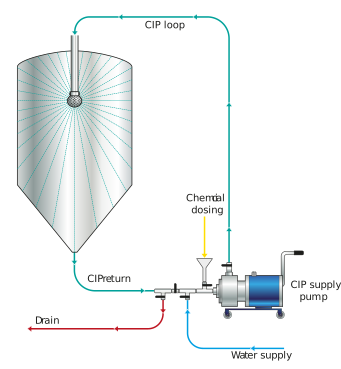
Figure: Single use CIP system