
Lesson 2 - Cleaning Systems and Control
This lesson explores the concepts of hygienic design and the Cleaning-in-Place (CIP) systems in the brewery. We examine the nature of soils, the chemicals used to remove them and how we can validate cleaning effectiveness. We also consider the optimisation of modern cleaning systems within the brewery.
Detergent Additives
Surfactants
In breweries, water is always used as the medium for carrying the detergents used to clean brewing plants. However, water has a relatively high surface tension, which is the tendency of water surfaces to shrink into the minimum surface area possible rather than wetting the surface.
Surfactants ‘surface-active’, otherwise referred to as wetting agents, are used to reduce the surface tension of water and allow better surface contact.
Through the reduction of surface tension, the cleaning agent can enter the soil from underneath and on the surface, resulting in easier wetting and quicker soil removal. Caustic CIP detergent formulations sometimes use non-ionic surfactants, such as fatty alcohols, which are low foaming.
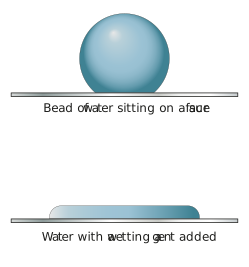
Figure: Action of surfactants or wetting agents
Sequestrants and chelating agents
Water hardness comprises of largely calcium and magnesium salts while other metals are able to form metal oxide and/or carbonate scale or deposits. Iron and manganese are examples of these. These metal ion complexes interfere with the cleaning ability of detergents and in extreme cases can exist as inorganic scale deposits on the vessel or pipe surface.
A chelating agent can form a water-soluble complex with the metal ions in the environment, thereby minimising the potential of deposit formation.
The most commonly used chelating agents are EDTA (ethylene-diamine-tetra-acetate), NTA (nitrile-tri-acetate) and gluconate. Sequestering agent examples are the phosphonates and polyphosphates.
Chelating and sequestering agents remove metal ions from a solution by forming a complex with that particular metal ion. This process is called chelation. It can be used to remove water hardness or heavy metals from the water.
Many chelants and sequestrants have metal ion preferences, which means the chelant or the sequestrant will bind with a particular metal ion before binding with other metal ions in that system.
The key difference between a chelating agent and sequestering agent is that a chelating agent binds with a single metal ion whereas a sequestering agent binds with many (up to 1000 ions) and inhibit scale crystal growth.