
Lesson 2 - Cleaning Systems and Control
This lesson explores the concepts of hygienic design and the Cleaning-in-Place (CIP) systems in the brewery. We examine the nature of soils, the chemicals used to remove them and how we can validate cleaning effectiveness. We also consider the optimisation of modern cleaning systems within the brewery.
Sinner’s Circle – The Four Cleaning Factors
The four factors for effective cleaning were devised by chemical engineer Herbert Sinner in 1959 and form the basis around which modern CIP systems are designed.
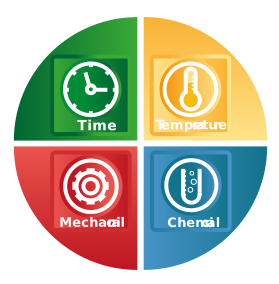
Figure: The four factors of cleaning (Sinner’s Circle)
The four factors need to be considered as a whole. A reduction in one quadrant needs to be balanced by an increase of one or more of the other quadrant factors. The design of cleaning the plant and the incorporation of the four factors will depend on:
a) The nature and load of the soil
b) The limitations of the equipment being cleaned
c) The equipment doing the cleaning
d) The standard of cleanliness and sanitation required
- Mechanical action refers to the physical removal of soil through pressure or frictional forces generated by a turbulent flow. The greater the mechanical action applied, the more effective and quicker the cleaning becomes. In modern brewing cleaning systems, mechanical action has been incorporated into higher pressure systems such as rotary jet cleaning, which we will discuss later.
- Chemical type, formulation and concentration each have a role to play. Detergent formulations are made more effective through the addition of compounds that increase wettability and sequestering power, which is the ability to bind metal ions that can cause scale, e.g. calcium and magnesium. Additives make the base cleaning agent more expensive, but this may be crucial, for example, if the water used for cleaning contains temporary or permanent hardness, which can form scale on surfaces.
- Temperature increases the cleaning effectiveness up to an optimum point, depending on the detergent used. However, detergent formulations may become unstable at high temperatures, which causes the precipitation of dissolved soil substances and reduces effectiveness. Increased temperature means increased energy use, something that needs to be optimised in the modern brewery. Due to the risk of damaging equipment, certain areas of the plant are cleaned cold, such as fermenting and maturation vessels. In these areas, we supplement with mechanical action and chemical make-up to ensure cleaning effectiveness.
- Time is at a premium in the brewing process, and often cleaning duration is limited in order to turn equipment around quickly. This requires shortened cleaning cycles, perhaps using only a hot water sterilisation step, such as in the case of filtration and packaging fillers (where a full cleaning cycle is performed during planned stoppage times). One of the key objectives in CIP is to balance cleaning time with production scheduling needs.
Where in the brewery do we need to substitute one or more of the Sinners Circle cleaning factors with others and why would we need to do this?
Give yourself 5-10 minutes to think about this, and then click ‘Next’ to continue with this lesson.