
Lesson 7 - Beer Flavour and Stability SAQ
This lesson allows you to test yourself on the material covered in the lesson on Beer Flavour and Stability and determine the level to which you have met the learning outcomes.
Suggested Response - Q4
**Discuss the flavour changes that happen during beer storage after packaging and pasteurisation, and how the beer can be managed during and after packaging to minimise these changes.
Response:
Pasteurisation, or other techniques for removing microbes, should effectively leave beer sterile so that microbial growth does not take place. Flavour changes will, therefore, be limited to changes in the chemical components of beer.
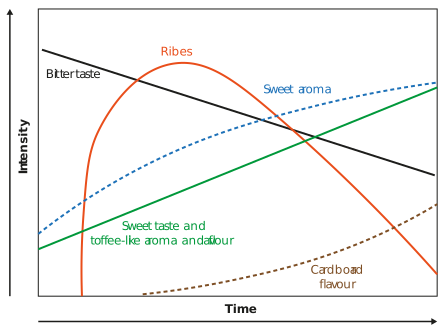
The general changes in packaged beer are shown above, although changes are dependent on the beer style and higher alcohol. Lower alcohol lagers tend to develop ribes and cardboard flavours while ales develop sweeter notes with age. Darker beers are more resistant to change.
The ribes flavour refers to the taste standard ‘catty’, which is an unpleasant flavour of tomcat urine formed during the ageing of beer. It is associated with high packaging dissolved oxygen (DO) levels.
After packaging, beer flavour change is influenced by the amount of oxygen and metal ions in the beer, which needs to be as low as possible. It is important to invest in the best packaging technology possible to ensure this is achieved. A suitable number would be < 50 µg/L total dissolved oxygen in package.
Oxygen by itself is not reactive. Its reactive species (ROS), consisting of free radicals and other species, catalyse oxidation reactions as beer ages. The ROS consist of the superoxide radical (•O2−), hydrogen peroxide (H2O2) and the very reactive hydroxyl radical (•OH). Formation of ROS is catalysed by metal ions found in beer, in particular, iron and copper, through the Haber-Weiss and Fenton reactions.
Oxidation of unsaturated fatty acids (to form staling aldehydes) is one of the key changes in a beer’s flavour instability. One of these aldehydes, E-2-nonenal (E-2N), is responsible for the cardboard flavour in aged beer. The reactions, resulting in E-2N, happen during mashing. The aldehydes are bound with sulphur dioxide until they are released during ageing in package.
A decrease of bitterness is due to the oxidation of iso-α-acids, particularly the trans forms. Dry hopped beers also suffer from a loss of hop aroma over time.
Temperature plays a significant role in flavour change, and beers stored cold will remain much more flavour stability. For each 10 °C increase in temperature, the flavour changes will be increased two to three-fold.
Yeast health improves the freshness of beer. Healthy yeast can reduce staling carbonyls to their corresponding alcohols. They can absorb and convert diacetyl to flavour inactive compounds.