
Lesson 8 - Fermentation Unit Final SAQ
You have now completed the Fermentation unit. This lesson provides the opportunity to test your knowledge with a last set of self-assessment questions.
Suggested Response - Q4
***Answer ALL parts of this question. Your brewery is beginning a major upgrade. Your role is to design the new fermentation plant. The current system of closed 500 hL box fermenters, arranged over four floors, is to be replaced with a tank farm of cylindroconical vessels, each with a capacity of 5,000 hL.
a) Draw a diagram showing the principal features of the vessels you intend to install.
b) What are the advantages that you expect to gain from the layout and use of the new tank farm?
c) Do you foresee any gains to be made with regard to yeast handling and quality?
d) What problems do you think will need to be overcome?
Response:
a) The main features of a typical cylindroconical fermenting vessel are shown in the following figure:
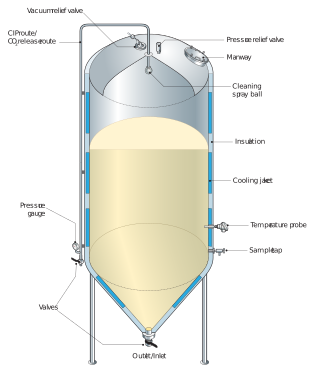
Figure: Principal features of a cylindroconical fermenter
b) The new cylindroconical vessels will be arranged in a tank farm, with the lower parts within a new enclosed building and the tops projecting through the roof into the open air.
The advantages will be:
The new set-up is much simpler than the old and makes efficient use of the available space. All the tanks will be on one floor which makes filling and emptying simpler and more manageable with less pumping. The old system would have been difficult to service with regard to the operations of filling, wort cooling, wort oxygenation, pitching, cropping, vessel emptying and cleaning, and CO2 collection. All of these unit operations would be feasible using a single system.
The larger batch sizes will require fewer fermentation cycles to obtain the same volumes of beer. Since there will be fewer, larger batches it is likely that consistency of both fermentation performance and beer quality will be improved. Temperature control is better in the new vessels.
c) Cropping from closed box fermenters is difficult. The yeast is removed after the beer and is often a manual operation. Cropping from cylindroconical vessels is more efficient and can be automated, so there will be some manpower savings. There will be fewer and bigger crops. These are removed before the beer and so there is some flexibility as to when this can be done, maybe warm and early if the yeast health suffers using the new larger vessels.
d) Bottom cropping has some disadvantages. Most of these will remain and some will, to some extent, be exacerbated by the bigger and taller vessels. The cone is a hostile environment for yeast, especially in large vessels where there is a high hydrostatic pressure due to the tall column of liquid. When the crop has formed in the cone it is difficult to control the temperature of the packed yeast since the cells continue to generate heat and this is not easily dissipated or cooled via external jackets. The crop is heterogenous because larger and more flocculant cells drop out first; therefore, a choice has to be made about the proportion of the crop to retain for re-pitching. The crop is always contaminated with trub and other non-yeast solids and this can cause pitching rate errors if not corrected for.
The yeast handling plant will need to be upgraded to cater for the bigger batch size.