
Lesson 8 - Fermentation Unit Final SAQ
You have now completed the Fermentation unit. This lesson provides the opportunity to test your knowledge with a last set of self-assessment questions.
Suggested Response - Q2
**Answer ALL parts of this question:
a) With the aid of a diagram, describe the relationship between diacetyl formation by yeast during fermentation and the pathway responsible for the synthesis of valine.
b) What is the difference between VDK and diacetyl?
c) Explain why VDK concentration reaches a maximum value in mid to late fermentation and then declines.
Response:
a) Diacetyl is formed during fermentation as an off-shoot of the ILV (iso-leucine valine) pathway which is responsible for the synthesis of the amino acid, valine, from pyruvate.
The first step in this pathway is the conversion of pyruvate into α-acetolactate. A proportion of α-acetolactate is transported out of the cell into the fermenting beer where it undergoes a spontaneous oxidative decarboxylation to give diacetyl.
This is shown in the following figure:
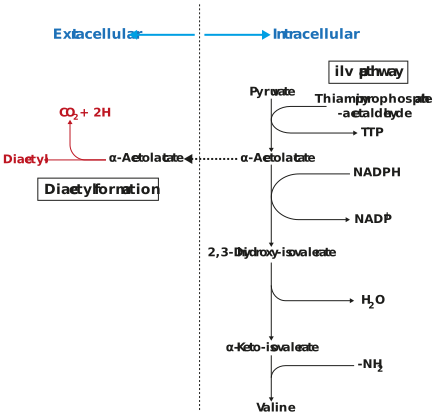
Figure: the ILV pathway and the route for diacetyl formation
b) VDK stands for vicinal diketones and is a whole group of compounds formed during fermentation which contain two ketone groups linked to adjacent carbon atoms. Diacetyl is just one of these compounds.
In brewing fermentations where diacetyl is relevant, it is usual to refer to ‘total VDK’. This is not an accurate description of what is really present but is an important distinction. The spontaneous conversion of α-acetolactate into free diacetyl is usually the rate-limiting step in the diacetyl pathway. This is why, before analyses are performed, the sample is heated to ensure that all the precursor α-acetolactate is converted into free diacetyl.
During fermentation most of the diacetyl is actually α-acetolactate. It is called total VDK because the analysis gives α-acetolactate plus free diacetyl.
c) The shape of the VDK profile is all about wort FAN concentration and how this is taken up by yeast and used during fermentation. There is always some valine in the wort but this is not taken up until mid fermentation. This means that in early fermentation the yeast has to synthesise valine and therefore the ILV pathway is active and VDK concentration increases.
In mid fermentation, when valine begins to accumulate inside the cells, the ILV pathway is no longer needed. The presence of valine feeds back and inhibits the enzyme responsible for catalysing the first step, pyruvate to α-acetolactate. This stops VDK formation and from the peak value it begins to drop.