
Lesson 7 - Design of Fermentation Vessels SAQ
This lesson enables you to test yourself on the material covered in the Design of Fermentation Vessels lesson and determine to what level you have attained the outcomes.
Suggested Response - Q3
***Answer ALL parts of this question:
a) What is meant by the term uni-tanking?
b) What are the major differences between vessels designed for primary fermentation and those designed as dual-purpose vessels?
c) Describe what changes would be needed to the process to incorporate a system for continuous maturation.
Response:
a) Uni-tanking is the practice of carrying out primary fermentation and cold conditioning in the same vessel.
b) A dual-purpose vessel is used for the process of uni-tanking. The main way in which this differs from a primary fermentation vessel is the need to increase the cooling capacity to allow it to reach, and control at, the much lower temperatures needed for cold conditioning. In addition, a dosing system might be required to add stabilisation process aids, and maybe a small mechanical stirrer both to ensure good dispersion of process aids and as a means of preventing layering since natural convection currents are very small under these conditions.
c) Continuous maturation systems have been proposed by some, and used at commercial scale by a few, to remove diacetyl by passing green beer thorough a reactor which contains a very high concentration of yeast. Usually the yeast will be immobilised using an inert support or an entrapment method.
The design of an immobilised yeast reactor suitable for this application is shown in the following figure.
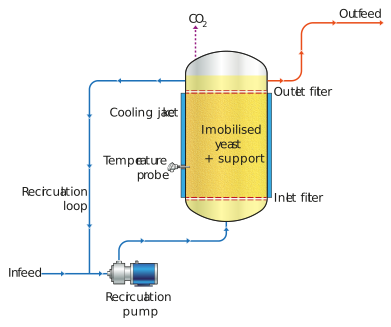
Figure: Design of an immobilised yeast reactor suitable for continuous maturation
Incorporation of the continuous maturation system into the current process would need modification as follows:
Beer would be moved from primary fermentation as soon as attenuation gravity was achieved. The green beer would then be passed through the continuous maturation tank. Before this could be done it would be necessary to carry out some pre-treatments. These are removal of as much yeast as possible using an in-line continuous centrifuge, and heating the beer to ensure that all precursor α-acetolactate is converted into free diacetyl. This step must be carried out under strictly anaerobic conditions to prevent oxidation of the beer. After cooling, the beer is passed through the reactor and diacetyl reduced to levels below the flavour threshold. The following diagram shows the elements of the system.
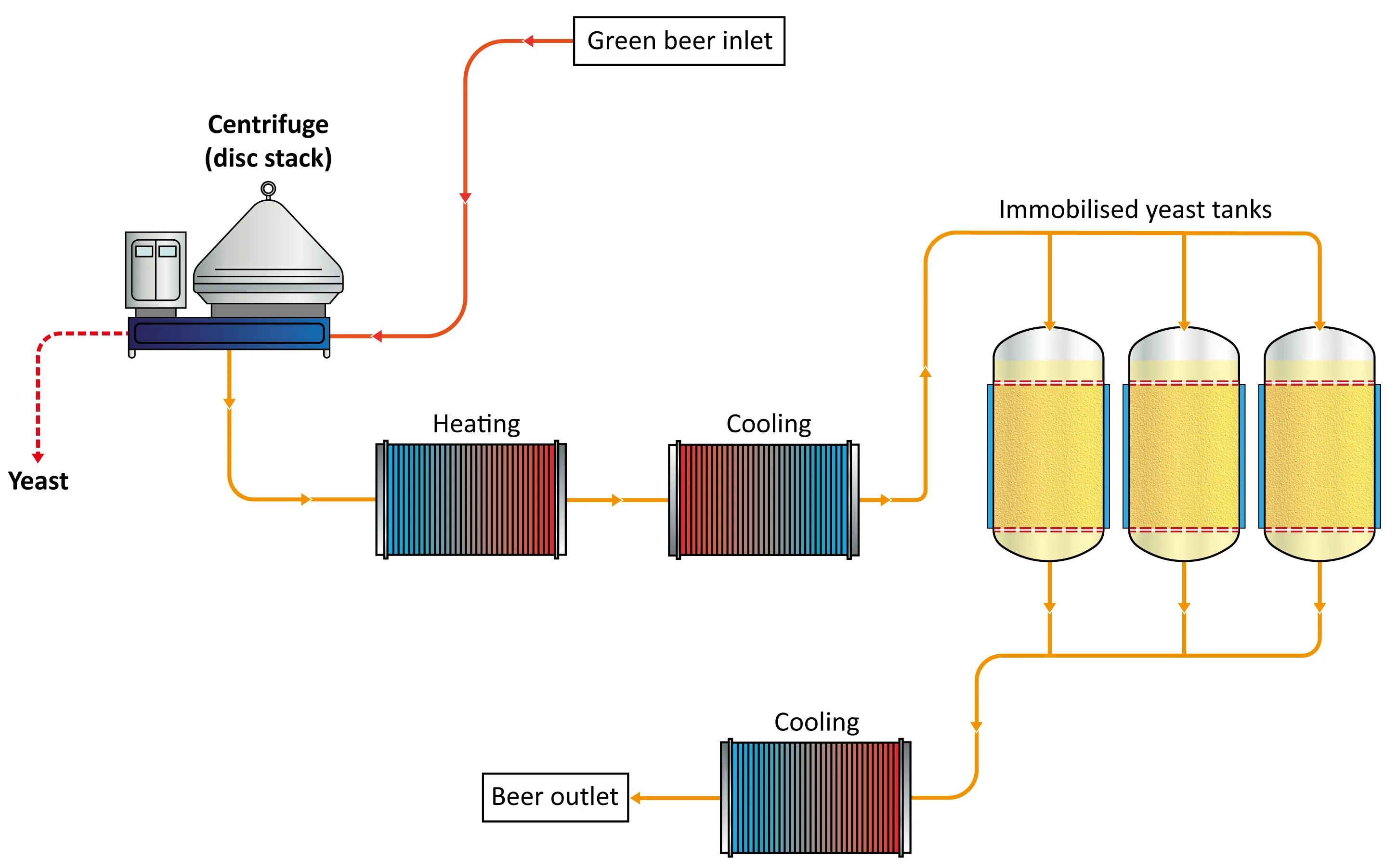
Figure: Diagram showing the features of a continuous maturation plant
After this maturation step it would be necessary to transfer the beer to a separate conditioning tank to carry out whatever treatments are considered necessary to give the finished beer the desired degree of colloidal stability.