
Lesson 7 - Design of Fermentation Vessels SAQ
This lesson enables you to test yourself on the material covered in the Design of Fermentation Vessels lesson and determine to what level you have attained the outcomes.
Suggested Response - Q2
**Answer BOTH parts of this question:
a) With the aid of a suitable diagram, describe the processes that are carried out during the fill of a cylindroconical fermenting vessel.
b) You have just installed some new, bigger cylindroconical fermentation vessels. The fill time for the new vessels is 20 hours and it requires six batches of wort, twice as long as the old vessels and three more batches of wort. Initial trials in the new vessels have shown that beer ester levels are significantly lower than standard. Why might this have happened and what steps would you take to reverse the changes?
Response:
a) All of the processes that need to be carried out to begin a new fermentation in a cylindroconical vessel are carried out during the transfer of hot wort from the brewhouse.
These are:
-
Wort cooling (via an in-line heat exchanger, the paraflow).
-
Possibly wort dilution to achieve the desired gravity; sterile brewing water added in-line using a blending system based on an in-line gravity meter.
-
Wort oxygenation, using sterile air or pure oxygen, dosed in-line, either on the hot side of the paraflow or more usually the cold side. An in-line dissolved oxygen meter may be placed down-stream of the addition point.
-
Yeast pitching, yeast slurry added in-line at a point after the oxygen addition point.
A typical set-up is shown in the following diagram.
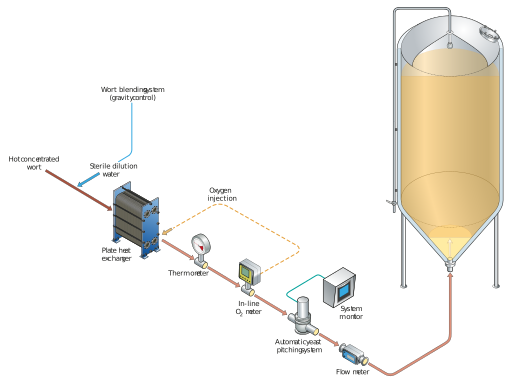
Figure: System for initiation of a fermentation for a cylindroconical fermenter
b) The only changes that have been introduced are the bigger vessels and longer fill time; therefore, the changes in beer ester levels are probably associated with this setting up phase of the fermentation.
The important point is that at typical fermentation temperatures the yeast will begin to move from lag phase to active growth and the start of budding in about four to six hours. Obviously, this is well before wort addition is complete if all the yeast is pitched with the first batch of wort, as would be usual to avoid the risk of spoilage.
The result is that compared with the original fermentations, the yeast will be exposed to fresh oxygenated wort for much longer. Oxygen both inhibits the terminal enzyme, alcohol acyl transferase, in acetate ester formation (see figure below) and represses the ATF genes which code for it.
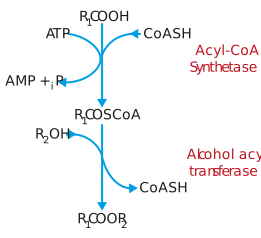
Figure: Terminal steps of acetate ester synthesis by yeast
This effect would explain the drop in esters, observed under the new fermentation regime, since the yeast is exposed to oxygen for much longer and during the critical early phase of fermentation.
In correcting the change, the key is to consider when to pitch in relation to oxygenation. The fill time and need for multiple wort batches provides a lot of flexibility. In order to raise ester levels, it is necessary to limit the exposure time to oxygen. Ways of doing this are either to pitch late in the wort fill or to not oxygenate all batches of wort. From a purely scientific point of view, it would be best to pitch the yeast at the end of fill because all the yeast would undergo the transition from storage conditions to warm oxygenated wort simultaneously, thereby giving a good controlled start to the fermentation. However, unless there is great confidence in hygiene, this is not a likely choice. The option likely to be taken up would be to continue to pitch early and to oxygenate the early batches of wort but not the later ones (or a variation on this theme to be confirmed by trial).